Welcome to a space where excellence is imagined, practiced, and built

This blog is designed for professionals who see operational reliability not just as a technical field, but as a mindset that shapes resilient, high‑performing organizations. Here you’ll find insights that challenge assumptions, stories that inspire action, and reflections that connect engineering, culture, leadership, and operational performance. If you’re driven by the pursuit of safer, smarter, and more human‑centered operations, you’re in the right place. Explore, learn, and join us as we build a community committed to turning operations into sustainable excellence.

By Víctor Lameda … , 9 April 2026

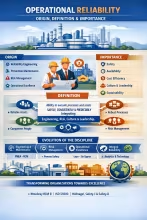
Operational Reliability: Origin, Essence, and Evolution of a Discipline that Transforms Organizations

Introduction

In a world where industrial operations are increasingly complex, interconnected, and demanding, Operational Reliability has emerged as a strategic discipline to ensure that assets, processes, and decisions perform safely, consistently, and predictably. It is not merely a set of technical tools—it is a management philosophy that integrates engineering, culture, leadership, and data-driven decision-making.

By Víctor Lameda … , 8 April 2026

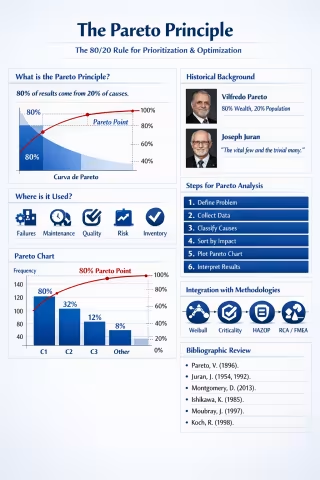
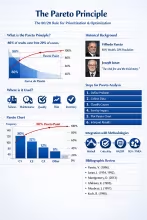
The Pareto Principle: History, Foundations, Applications, and Graphical Representation

Abstract

The Pareto Principle, commonly known as the 80/20 rule, states that a small number of causes often account for the majority of effects. This concept, rooted in economics and later adopted in quality management and reliability engineering, serves as a cornerstone for prioritization, resource optimization, and continuous improvement.

1. Definition

The Pareto Principle asserts that:

Tags

By Víctor Lameda … , 6 April 2026

JUST‑IN‑TIME (JIT): PHILOSOPHY, METHOD, AND STRATEGY FOR OPERATIONAL EFFECTIVENESS


1. What is Just‑in‑Time?

Just‑in‑Time (JIT) is a management and production philosophy that aims to produce only what is needed, in the quantity needed, and at the time needed. Its purpose is to eliminate waste, reduce inventories, shorten cycle times, and synchronize the entire value chain.

Tags

By Víctor Lameda … , 5 April 2026

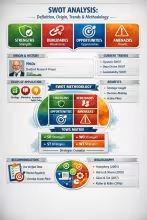
SWOT Analysis: Definition, Origin, Trends, Methodology, and Applications

Abstract

The SWOT Analysis—an acronym for Strengths, Weaknesses, Opportunities, and Threats—is one of the most widely used strategic tools in management, innovation, and decision-making. This article presents its definition, historical origin, evolution, current trends, fields of application, benefits, detailed methodology, usage recommendations, and a bibliographic review in APA format.

By Víctor Lameda … , 5 April 2026

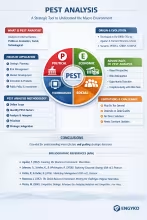
PEST Analysis: A Strategic Tool to Understand the Macro Environment

Abstract

The PEST Analysis is a strategic methodology used to evaluate Political, Economic, Social, and Technological factors that influence an organization’s performance and sustainability. This article presents its definition, origin, evolution, fields of application, detailed methodology, advantages, limitations, and bibliographic references.

Content below