Welcome to a space where excellence is imagined, practiced, and built

This blog is designed for professionals who see operational reliability not just as a technical field, but as a mindset that shapes resilient, high‑performing organizations. Here you’ll find insights that challenge assumptions, stories that inspire action, and reflections that connect engineering, culture, leadership, and operational performance. If you’re driven by the pursuit of safer, smarter, and more human‑centered operations, you’re in the right place. Explore, learn, and join us as we build a community committed to turning operations into sustainable excellence.
By Víctor Lameda … , 16 April 2026

When Hatred Becomes a Tool: A Reflection on Rebuilding Brotherhood

One of the deepest and most persistent problems in many nations is not only political or economic. It is emotional. It is cultural. It is the normalization of hatred as a tool for collective manipulation. When resentment becomes political language, when distrust becomes a social habit, and when identity is defined by opposition rather than coexistence, a society enters a cycle of fragmentation that corrodes everything it touches.

By Víctor Lameda … , 15 April 2026

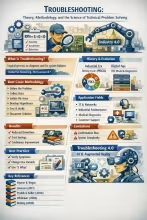
Troubleshooting: Theory, Methodology, and the Science of Technical Problem Solving

Abstract:
Troubleshooting is a systematic form of problem-solving aimed at identifying the root cause of failures in products or processes. This article reviews its logical structure, its evolution from simple mechanics to complex digital systems, and the trends transforming this art into a predictive science.

By Víctor Lameda … , 14 April 2026

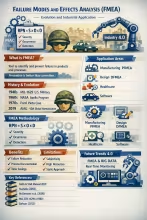
Failure Mode and Effects Analysis (FMEA): A Comprehensive Review of Its Evolution and Industrial Application

Abstract:
Failure Mode and Effects Analysis (FMEA) has established itself as the most robust risk prevention tool in reliability engineering. This article explores its theoretical foundation, from its military genesis to its integration into Industry 4.0 frameworks, analyzing its current capabilities and challenges.

By Víctor Lameda … , 11 April 2026

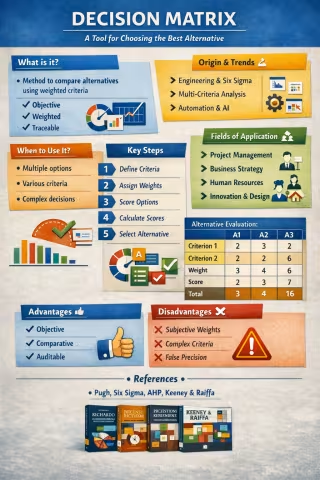
Decision Matrix: A Key Tool for Selecting the Best Alternative in Complex Environments

Tags

By Víctor Lameda … , 11 April 2026

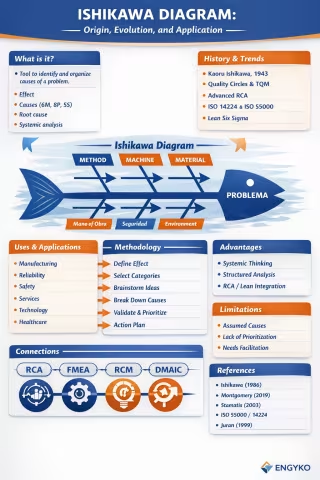
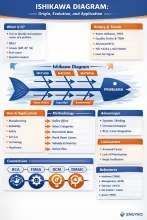
Ishikawa Diagram: Origin, Evolution, and Application in Continuous Improvement

Abstract

The Ishikawa Diagram, also known as the Cause‑and‑Effect Diagram or Fishbone Diagram, is one of the most influential tools in quality management, reliability engineering, and structured problem solving. Its purpose is to identify, organize, and visualize potential causes that lead to a problem, enabling deep analysis and evidence‑based decision‑making.

By Víctor Lameda … , 11 April 2026

Inequality as the Real Terrain: How the Differences That Divide Us Can Also Drive Us Forward

We are told that “everyone is equal,” yet daily experience proves otherwise. Equality functions as a moral and legal ideal, not as a description of reality. Life unfolds across a landscape of asymmetries—economic, social, ethnic, political, cognitive, physical, and cultural. And while these differences may seem unjust, they also open unexpected spaces for creativity, resilience, and success.

By Víctor Lameda … , 10 April 2026

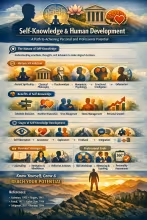
Self-Knowledge and Human Development: A Path to Achieving Personal and Professional Potential

Self-knowledge is one of the fundamental competencies for holistic development. Understanding who we are, how we think, what emotions arise in different contexts, and which values guide our actions allows us to build a life that is coherent, balanced, and purposeful. Far from being an abstract concept, self-knowledge has become a cornerstone of modern psychology, emotional intelligence, and professional growth.

By Víctor Lameda … , 10 April 2026

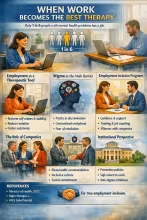
WHEN WORK BECOMES THE BEST THERAPY

To say that employment can become the best therapy is to recognize that work is not only a source of income but also a pillar of identity, stability, and emotional recovery. For people with mental health conditions, gaining access to decent work can mean the difference between exclusion and full reintegration into society. Yet, only one in six people with mental health problems has a job, a figure that reflects structural barriers, stigma, and the lack of inclusive policies.

Content below