
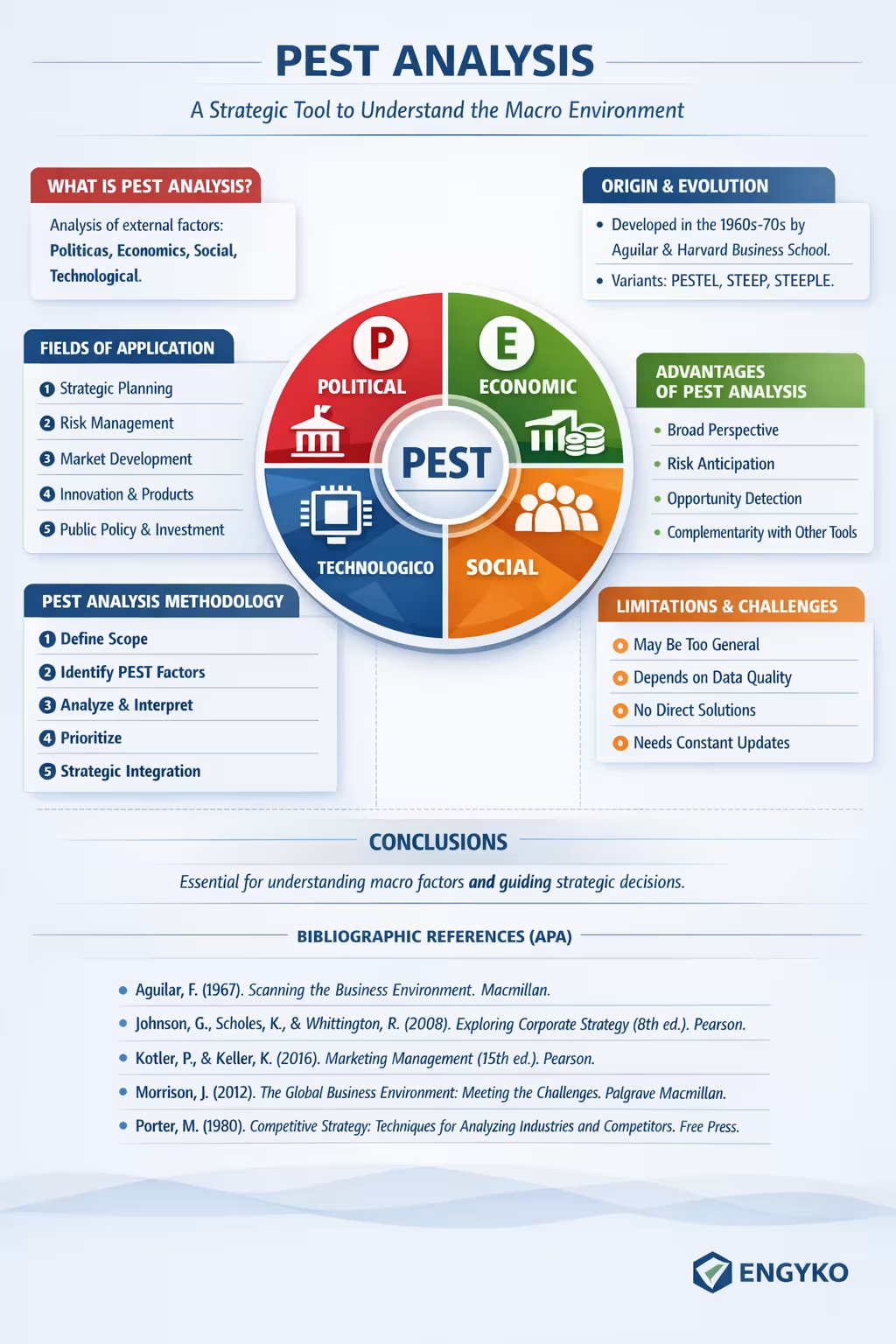
PEST Analysis: A Strategic Tool to Understand the Macro Environment
Abstract
The PEST Analysis is a strategic methodology used to evaluate Political, Economic, Social, and Technological factors that influence an organization’s performance and sustainability. This article presents its definition, origin, evolution, fields of application, detailed methodology, advantages, limitations, and bibliographic references.
1. What is PEST Analysis?
PEST Analysis is a diagnostic tool that examines external macro-environmental factors affecting an organization. Its purpose is to anticipate risks, identify opportunities, and guide decision-making in dynamic contexts.
The acronym PEST stands for:
- P – Political
- E – Economic
- S – Social
- T – Technological
Extended versions include Environmental and Legal dimensions, forming models such as PESTEL or PESTLE.
2. Origin and Evolution
The study of external environments emerged in the 1960s and 1970s, notably through:
- Francis Aguilar (1967), who introduced the ETPS framework (Economic, Technical, Political, Social).
- Harvard Business School, which formalized environmental scanning as part of strategic management.
Over time, ETPS evolved into PEST, a more intuitive acronym. Globalization and technological advances led to variants such as:
- PESTEL (Environmental and Legal)
- STEEP (Social, Technological, Economic, Environmental, Political)
- STEEPLE (adds Ethical)
These adaptations reflect the growing complexity of global environments.
3. Use and Fields of Application
PEST Analysis is widely used across industries and organizational levels. Key applications include:
3.1 Strategic Planning
Identifies macro trends affecting competitiveness and sustainability.
3.2 Risk Management
Anticipates regulatory, economic, or technological threats.
3.3 Market Development
Assesses countries, regions, or segments before expansion.
3.4 Innovation and Product Development
Detects social and technological changes driving new solutions.
3.5 Public Policy and Institutional Analysis
Used by governments and NGOs to evaluate policy impacts.
3.6 Investment Projects
Helps investors assess stability, trends, and macroeconomic risks.
4. PEST Analysis Methodology
The methodology generally follows five structured phases.
4.1 Phase 1: Define Scope
- Determine geographic and sectoral focus.
- Set time horizon (short, medium, long term).
4.2 Phase 2: Identify PEST Factors
Gather data for each dimension:
- Political: stability, fiscal policy, trade regulations, international treaties.
- Economic: inflation, interest rates, GDP, employment, exchange rates.
- Social: demographics, culture, education, lifestyle, consumer behavior.
- Technological: digitalization, automation, R&D, patents, infrastructure.
Sources include multilateral organizations, national statistics, sector reports, and think tanks.
4.3 Phase 3: Analyze and Interpret
- Assess how each factor affects the organization.
- Classify as opportunities or threats.
- Identify critical trends and likelihood of occurrence.
4.4 Phase 4: Prioritize
Use:
- Impact-probability matrices
- Risk maps
- Qualitative or semi-quantitative scoring
Focus on the most influential factors.
4.5 Phase 5: Strategic Integration
Incorporate results into:
- Strategic plans
- SWOT analysis
- Risk management systems
- Technological roadmaps
- Investment evaluations
The value of PEST lies in its ability to inform high-level decisions.
5. Advantages of PEST Analysis
- Broad environmental perspective
- Risk anticipation
- Opportunity detection
- Simplicity and flexibility
- Complementarity with other tools (SWOT, Porter’s Five Forces, RCA)
6. Limitations and Challenges
- May be too general if scope is poorly defined.
- Depends on data quality.
- Does not provide direct solutions.
- Can become extensive with too many variables.
- Requires constant updates due to global volatility.
7. Conclusions
PEST Analysis is essential for understanding macro-environmental dynamics and anticipating changes that affect organizational strategy. Its simplicity and adaptability make it indispensable for leaders, consultants, and planners. Combined with other methodologies, it strengthens decision-making and institutional resilience.
8. Bibliographic References (APA)
Aguilar, F. (1967). Scanning the Business Environment. Macmillan.
Johnson, G., Scholes, K., & Whittington, R. (2008). Exploring Corporate Strategy (8th ed.). Pearson Education.
Kotler, P., & Keller, K. (2016). Marketing Management (15th ed.). Pearson.
Morrison, J. (2012). The Global Business Environment: Meeting the Challenges. Palgrave Macmillan.
Porter, M. (1980). Competitive Strategy: Techniques for Analyzing Industries and Competitors. Free Press.
Comments