
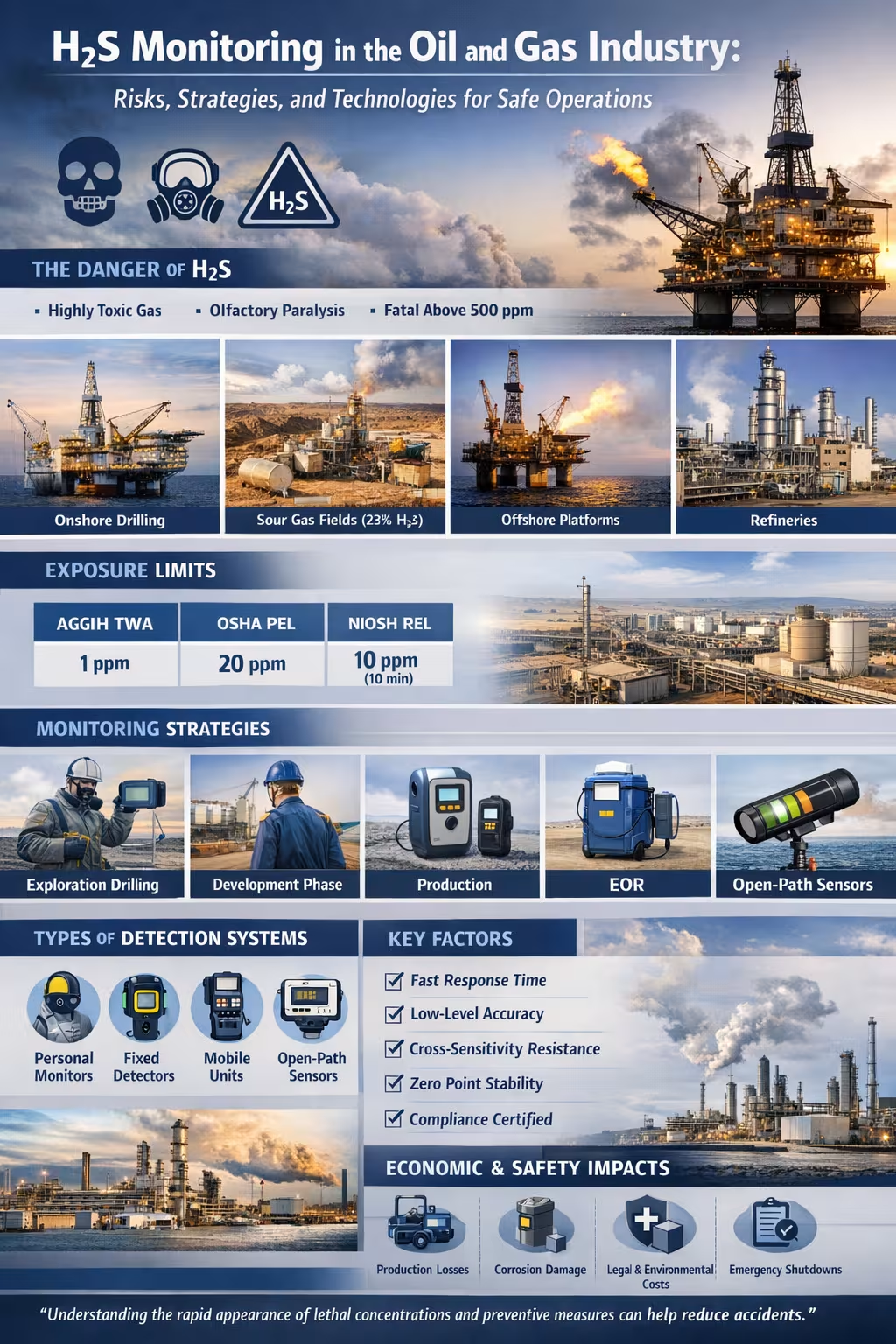
H₂S Monitoring in the Oil and Gas Industry: Risks, Strategies, and Technological Approaches
Abstract
Hydrogen sulfide (H₂S) remains one of the most critical hazards in the oil and gas industry due to its extreme toxicity, rapid physiological effects, and unpredictable presence in reservoirs and processing environments. This article synthesizes the key risks, exposure scenarios, regulatory limits, and monitoring strategies described in the provided technical document. The goal is to offer a clear, structured, and practical overview for organizations seeking to strengthen their H₂S safety programs across exploration, development, production, and refining operations.
1. Introduction
Hydrogen sulfide is a colorless, highly toxic gas naturally present in many oil and gas reservoirs. Even at very low concentrations, it poses significant health risks. The document emphasizes that H₂S can be detected by smell at 0.03 ppm, but this sense becomes unreliable because:
“It can paralyze the olfactory nerves… the natural alarm system in the nose becomes useless”
This characteristic makes continuous monitoring essential, especially because concentrations above 500 ppm can be life‑threatening and levels near 1000 ppm may cause instant death after a single inhalation.
2. Health Effects and Toxicological Profile
H₂S affects multiple physiological systems:
- Respiratory system: throat irritation, coughing, pulmonary edema, respiratory arrest
- Nervous system: dizziness, nausea, disorientation, loss of consciousness
- Cardiovascular system: rapid collapse at high concentrations
- Olfactory fatigue: inability to detect the gas after initial exposure
The document highlights that H₂S is heavier than air, accumulating near the ground and in confined spaces, increasing the risk of unnoticed exposure.
3. High-Risk Scenarios in Oil and Gas Operations
3.1 Onshore drilling and production
H₂S can be released during:
- Drill string removal
- Mud displacement
- Sample collection
- Well testing
Each reservoir may contain different H₂S concentrations, ranging from single‑digit ppm to significantly higher levels.
3.2 Sour gas fields
Sour gas reservoirs contain high percentages of H₂S. The document cites the Shuwaihat field (UAE), where stored gas contains 23% H₂S, requiring extreme safety measures.
“It is necessary to adopt extreme safety measures”
In “red zones,” workers must use self‑contained breathing apparatus (SCBA) with very high protection factors.
3.3 Offshore platforms
Unexpected H₂S in drilling mud, pipe connections, and living quarters poses severe risks. Storage and processing areas on tankers are also considered high‑risk zones.
3.4 Refineries
During the Claus desulfurization process, transfer points and surrounding evacuation areas must be monitored due to the possibility of sudden high‑concentration releases.
4. Economic Rationale for Continuous Monitoring
Beyond the human risk, H₂S incidents can cause:
- Equipment corrosion
- Environmental damage
- Production downtime
- Costly emergency responses
The document notes that well‑designed monitoring strategies can improve operational efficiency, especially by avoiding unnecessary installation of permanent systems during early exploration phases.
5. Occupational Exposure Limits
The document provides a comparative table of international exposure limits. Key values include:
- ACGIH TLV-TWA: 1 ppm
- ACGIH STEL: 5 ppm
- OSHA PEL: 20 ppm
- NIOSH REL: 10 ppm (10 minutes)
- EU: 5 ppm TWA / 10 ppm STEL
These limits guide alarm settings (A1 and A2) and define safe exposure thresholds for workers.
6. Monitoring Strategies Across the Project Lifecycle
6.1 Exploration drilling
- Geological predictions guide expectations
- Mobile monitoring is preferred
- H₂S content is uncertain
6.2 Evaluation phase
- Spot measurements during inspections
- No continuous monitoring yet
6.3 Development phase
- Mobile area monitoring
- Adjustments as construction progresses
6.4 Production phase
- Requires continuous, long‑term monitoring
- Installation of fixed gas detection systems is recommended
6.5 Enhanced Oil Recovery (EOR)
Gas injection increases the likelihood of sudden, extremely high H₂S releases.
7. Selecting Appropriate Monitoring Technologies
7.1 Types of monitoring
- Personal monitoring (portable detectors)
- Area monitoring (mobile systems)
- Fixed detection systems
- Open‑path gas detection for long‑distance coverage
Open‑path systems, traditionally used for hydrocarbons, can also detect toxic gases.
7.2 Key technical criteria
- Fast response time (t90)
- Accurate measurement at very low concentrations (<1 ppm)
- Rapid recovery after overexposure
- Zero‑point stability
- Minimal cross‑sensitivity (SO₂, NO, thiols, etc.)
- Compliance with IEC/EN 60079‑29‑2
- Data interfaces for emergency decision‑making
- Sensor durability and ease of maintenance
7.3 Environmental and installation considerations
- Wind direction and intensity
- Sand, snow, and extreme temperatures
- Sensor spacing
- Gas density and dispersion behavior
The document recommends using gas dispersion simulation software to optimize sensor placement.
8. Conclusion
H₂S remains a critical hazard in oil and gas operations. Its rapid toxicity, unpredictable presence, and ability to disable human smell make continuous monitoring indispensable. Effective H₂S safety programs require:
- Accurate risk assessments
- Appropriate monitoring technologies
- Worker training and emergency planning
- Integration of fixed and mobile detection systems
As the document states:
“Understanding the rapid appearance of lethal concentrations and the preventive measures can help reduce accidents”
A robust, site‑specific H₂S monitoring program is essential to protect workers, assets, and the environment.
References (APA Style)
Drägerwerk AG & Co. KGaA. (n.d.). Monitorización del H₂S en la industria del gas y el petróleo (PDF 91 092 69).
How to ensure H2S safety on offshore rigs. (2017). Retrieved from http://www.drillingcontractor.org/how-to-ensure-h2s-safety-on-offshore-rigs-8267 (drillingcontractor.org in Bing)
H2S control keeps gas from big offshore field on spec. (2017). Retrieved from http://www.ogj.com/articles/print/volume-89/issue-21/in-this-issue/general-interest/h2s-control-keeps-gas-from-big-offshore-field-on-spec.html (ogj.com in Bing)
Wintershall. (2017). Lagerstätte Shuwaihat – Erkundung und Bewertung. Retrieved from https://www.wintershall.com/
NIOSH. (2018). Hydrogen sulfide. Retrieved from https://www.cdc.gov/niosh/npg/npgd0337.html (cdc.gov in Bing)
CCOHS. (2018). Hydrogen sulfide. Retrieved from https://www.ccohs.ca/
Safe Work Australia. (2018). Workplace exposure standards for airborne contaminants. Retrieved from https://www.safeworkaustralia.gov.au/ (safeworkaustralia.gov.au in Bing)
GESTIS. (2018). Hydrogen sulfide. Retrieved from http://gestis.itrust.de/
Wintershall. (2018). Der Lebenszyklus eines Öl- und Gasfeldes. Retrieved from https://www.wintershall.com/
Comments