
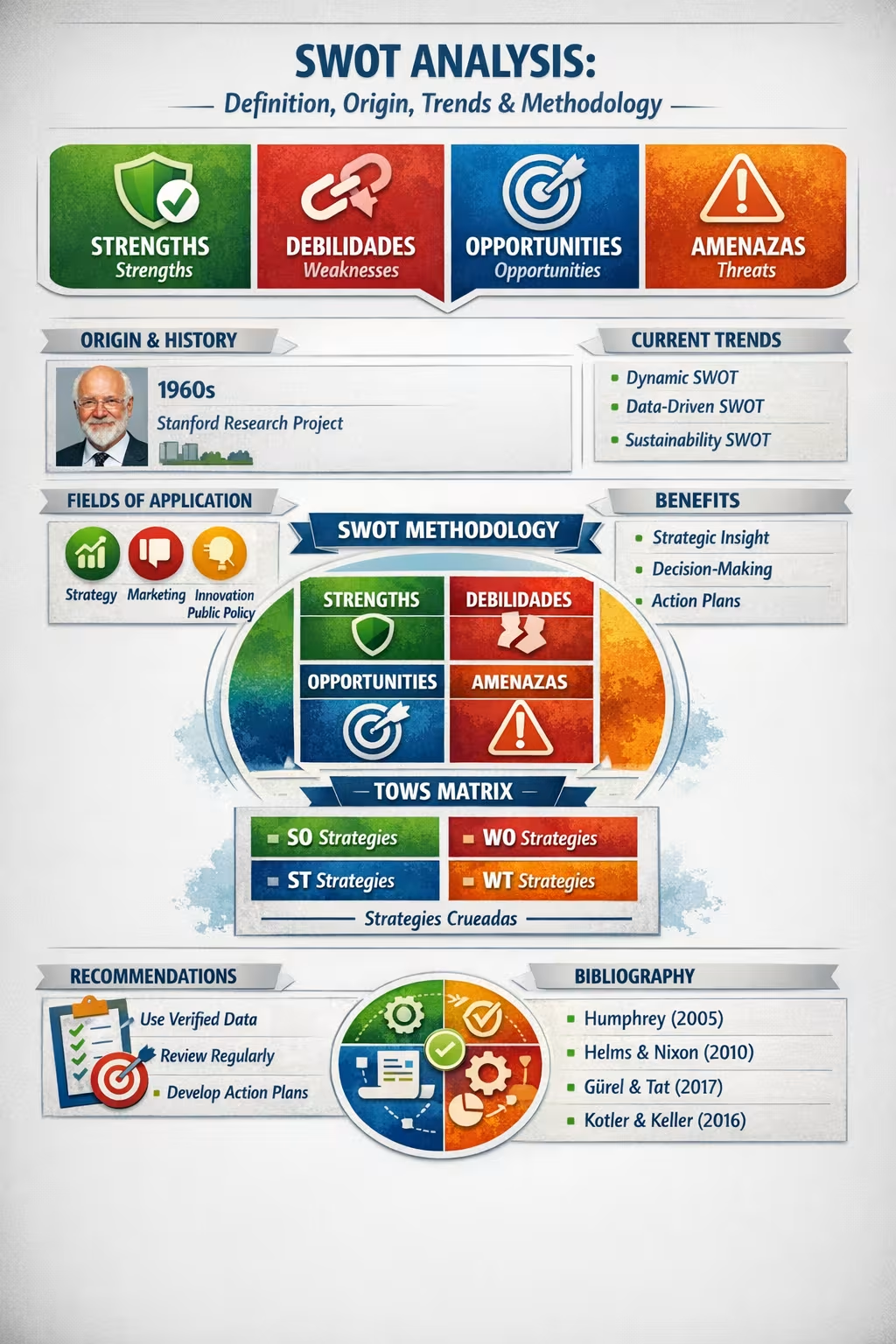
SWOT Analysis: Definition, Origin, Trends, Methodology, and Applications
Abstract
The SWOT Analysis—an acronym for Strengths, Weaknesses, Opportunities, and Threats—is one of the most widely used strategic tools in management, innovation, and decision-making. This article presents its definition, historical origin, evolution, current trends, fields of application, benefits, detailed methodology, usage recommendations, and a bibliographic review in APA format.
1. Definition
SWOT Analysis is a conceptual framework that evaluates the strategic position of an organization, project, process, or individual by identifying four key dimensions:
- Strengths: Internal capabilities that provide competitive advantage.
- Weaknesses: Internal limitations that hinder performance.
- Opportunities: External factors that can enhance success.
- Threats: External factors that may pose risks or challenges.
Its purpose is to integrate internal and external perspectives to support strategic decisions, prioritize actions, and guide planning.
2. Origin and Historical Evolution
SWOT Analysis originated in the 1960s as part of the Business Policy Research Project at Stanford University, led by Albert Humphrey. The project aimed to understand why corporate strategic plans often failed. Humphrey’s team developed a simple yet powerful framework that became globally recognized as SWOT.
Evolution Timeline
- 1980s: Incorporated into corporate strategic planning.
- 1990s: Combined with decision matrices (TOWS) and competitive analysis.
- 2000–2010: Adapted to agile methodologies and innovation management.
- 2010–2020: Applied in public administration, education, and social development.
- 2020–Present: Integrated with digital analytics, dashboards, and competitive intelligence tools.
3. Contemporary Trends
Modern applications of SWOT reflect a shift toward dynamic, data-driven, and sustainability-oriented approaches:
- Dynamic SWOT: Continuous updates in volatile environments.
- Data-Driven SWOT: Integration with analytics, KPIs, and dashboards.
- Innovation SWOT: Used in design thinking and product development.
- Sustainability SWOT: Incorporates ESG (Environmental, Social, Governance) factors.
- Digital SWOT: Applied to digital transformation and cybersecurity.
- Personal SWOT: Used in leadership and career development.
4. Fields of Application
SWOT Analysis is versatile and applicable across multiple domains:
- Corporate strategy and organizational planning
- Project management and PMO
- Marketing and competitive positioning
- Innovation and product development
- Public policy and governance
- Education and academic research
- Risk management and business continuity
- Entrepreneurship and startups
- Personal development and executive coaching
5. Benefits
- Simplicity and clarity: Easy to understand and apply.
- Comprehensive vision: Integrates internal and external factors.
- Strategic prioritization: Facilitates decision-making.
- Versatility: Applicable to diverse contexts.
- Improved communication: Creates a common language for teams.
- Action-oriented: Serves as a foundation for TOWS strategies.
- Critical thinking: Encourages reflection and evaluation.
6. Detailed Methodology
6.1 Preparation
- Define the objective (organization, project, process, or individual).
- Establish the time frame (short, medium, or long term).
- Form a multidisciplinary team.
- Gather internal and external data: KPIs, audits, market studies, PESTEL analysis, benchmarking, surveys, and interviews.
6.2 Internal Analysis: Strengths and Weaknesses
Evaluate controllable factors such as:
- Resources (financial, human, technological)
- Capabilities and competencies
- Processes and systems
- Organizational culture
- Brand and reputation
- Innovation and intellectual property
Guiding questions:
- What do we do better than competitors?
- What limitations affect our performance?
- What resources are unique or hard to imitate?
6.3 External Analysis: Opportunities and Threats
Assess uncontrollable factors:
- Market trends
- Competition
- Regulations
- Technology
- Economic, social, and political conditions
- Emerging risks
Guiding questions:
- What trends favor our growth?
- What risks could hinder our goals?
- What technological changes may impact us?
6.4 Building the SWOT Matrix
Organize findings into four quadrants:
Strengths
Weaknesses
Opportunities
Threats
6.5 Cross-Analysis (TOWS Matrix)
Strategic value emerges from cross-referencing factors:
- SO (Maxi-Maxi): Use strengths to exploit opportunities.
- ST (Maxi-Mini): Use strengths to mitigate threats.
- WO (Mini-Maxi): Overcome weaknesses by leveraging opportunities.
- WT (Mini-Mini): Minimize weaknesses and avoid threats.
6.6 Prioritization and Decision-Making
Use tools such as:
- Impact vs. probability matrices
- Decision trees
- Multi-criteria analysis
- Strategic roadmaps
6.7 Action Plan Development
Each strategy should include:
- Objective
- Responsible party
- Required resources
- Success indicators
- Deadlines
- Associated risks
7. Recommendations
- Base analysis on verified data, not assumptions.
- Update regularly, especially in VUCA environments.
- Involve multiple departments for a holistic view.
- Avoid bias and wishful thinking.
- Complement with other tools (PESTEL, benchmarking, risk analysis).
- Engage expert facilitators to reduce cognitive bias.
- Always translate SWOT insights into actionable strategies.
8. Bibliographic Review (APA 7th Edition)
Aguilar, F. (1967). Scanning the business environment. Macmillan.
Gürel, E., & Tat, M. (2017). SWOT analysis: A theoretical review. Journal of International Social Research, 10(51), 994–1006.
Helms, M. M., & Nixon, J. (2010). Exploring SWOT analysis—Where are we now? Journal of Strategy and Management, 3(3), 215–251.
Humphrey, A. (2005). SWOT analysis for management consulting. SRI Alumni Newsletter, 1–10.
Kotler, P., & Keller, K. (2016). Marketing management (15th ed.). Pearson.
Panagiotou, G. (2003). Bringing SWOT into focus. Business Strategy Review, 14(2), 8–10.
Pickton, D., & Wright, S. (1998). What’s SWOT in strategic analysis? Strategic Change, 7(2), 101–109.
Comments