Operational Reliability: Origin, Essence, and Evolution of a Discipline that Transforms Organizations
Introduction
In a world where industrial operations are increasingly complex, interconnected, and demanding, Operational Reliability has emerged as a strategic discipline to ensure that assets, processes, and decisions perform safely, consistently, and predictably. It is not merely a set of technical tools—it is a management philosophy that integrates engineering, culture, leadership, and data-driven decision-making.
This article presents an introductory overview of its origin, definition, importance, and evolution, offering a solid conceptual framework for those seeking to understand or implement this discipline within their organizations.
1. Origin of Operational Reliability
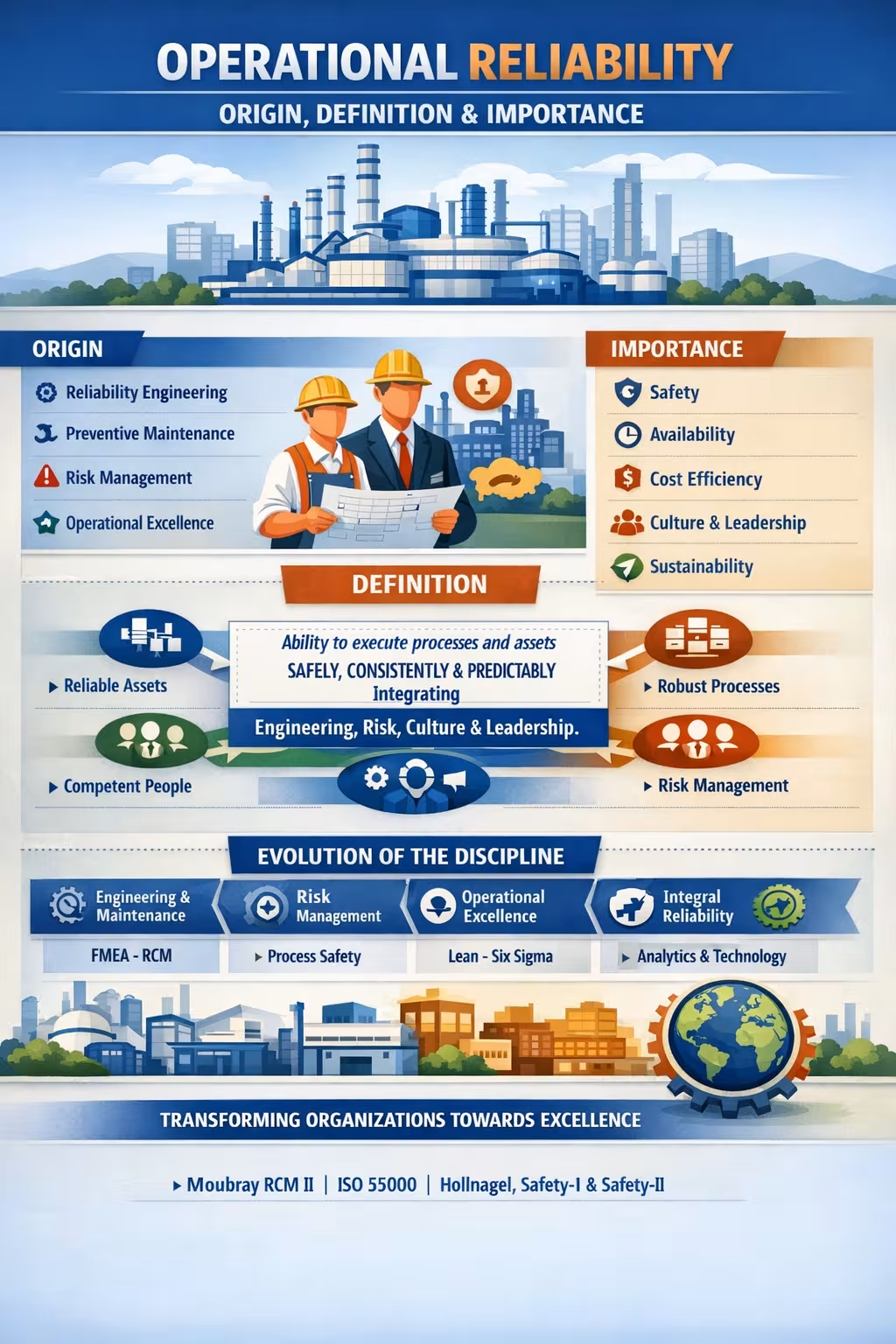
Operational Reliability arises from the convergence of several historical streams:
- Reliability Engineering, developed in the military and aerospace industries during the 1950s and 1960s, focused on ensuring systems performed their intended functions without failure.
- Productive and Preventive Maintenance, promoted by Japanese industry in the 1970s, introduced concepts such as TPM and operator involvement in equipment care.
- Risk Management and Process Safety, strengthened after major industrial accidents (Flixborough, Bhopal, Piper Alpha), highlighted the need to integrate safety, engineering, and organizational culture.
- Operational Excellence, which since the 1990s incorporated methodologies like Lean, Six Sigma, and integrated management systems.
Operational Reliability was born precisely at the intersection where these disciplines meet, evolve, and integrate to form a holistic approach.
2. Definition of Operational Reliability
Operational Reliability can be defined as:
The ability of an organization to execute its processes, assets, and decisions safely, consistently, and predictably—even under changing conditions—through the integration of engineering, risk management, organizational culture, and disciplined leadership.
This definition emphasizes four essential elements:
- Reliable assets — equipment designed, operated, and maintained to fulfill its intended function.
- Robust processes — standardized, controlled, and continuously improved procedures.
- Aligned and competent people — disciplined culture, clear roles, and coherent decision-making.
- Risk management — systematic anticipation, prevention, and mitigation of failures.
3. Strategic Importance
Operational Reliability is a direct enabler of value. Its benefits include:
a) Safety
Reduces incidents, deviations, and unsafe conditions by strengthening operational discipline and asset integrity.
b) Availability and Productivity
Increases effective operating time, reduces unplanned downtime, and optimizes resource utilization.
c) Cost Efficiency
Minimizes costs associated with failures, rework, production losses, and reactive maintenance.
d) Culture and Leadership
Promotes consistent behaviors, clarity in roles, shared responsibility, and evidence-based decision-making.
e) Sustainability
Supports cleaner, more efficient, and responsible operations aligned with global standards.
In essence, Operational Reliability not only improves indicators—it transforms how the organization thinks, acts, and learns.
4. Evolution of the Discipline
Operational Reliability has evolved from a technical focus to a comprehensive management model:
Stage 1: Engineering and Maintenance
- Failure Mode and Effects Analysis (FMEA/FMECA)
- Preventive and predictive maintenance
- Design for reliability
Stage 2: Risk Management and Process Safety
- HAZOP, LOPA, Bow-Tie
- Mechanical integrity
- Safety management systems
Stage 3: Operational Excellence
- Standardization
- Continuous improvement
- Indicators and governance
Stage 4: Operational Reliability as a Philosophy
- Integration of engineering, culture, and leadership
- Operational discipline
- Data-driven decision-making
- Digital platforms and advanced analytics
Today, Operational Reliability is understood as a socio-technical system, where technology, processes, and people must align to achieve safe, reliable, and human-centered operations.
Conclusion
Operational Reliability is more than a methodology—it is a way of thinking and managing. Its technical origins have evolved into an integrated approach combining engineering, culture, leadership, and risk management. In an environment where uncertainty is constant, this discipline becomes a pillar for sustainability, competitiveness, and excellence.
Organizations that embrace Operational Reliability do not merely reduce failures—they build a safer, more efficient, and more human future.
Suggested References
- Moubray, J. (1997). Reliability-Centered Maintenance (RCM II). Industrial Press.
- Smith, A. M., & Hinchcliffe, G. (2004). RCM—Gateway to World Class Maintenance. Elsevier.
- International Organization for Standardization. (2014). ISO 55000: Asset Management — Overview, Principles and Terminology.
- Hollnagel, E. (2014). Safety-I and Safety-II: The Past and Future of Safety Management. Ashgate.
- Hopkins, A. (2009). Failure to Learn: The BP Texas City Refinery Disaster. CCH Australia.
Comments