
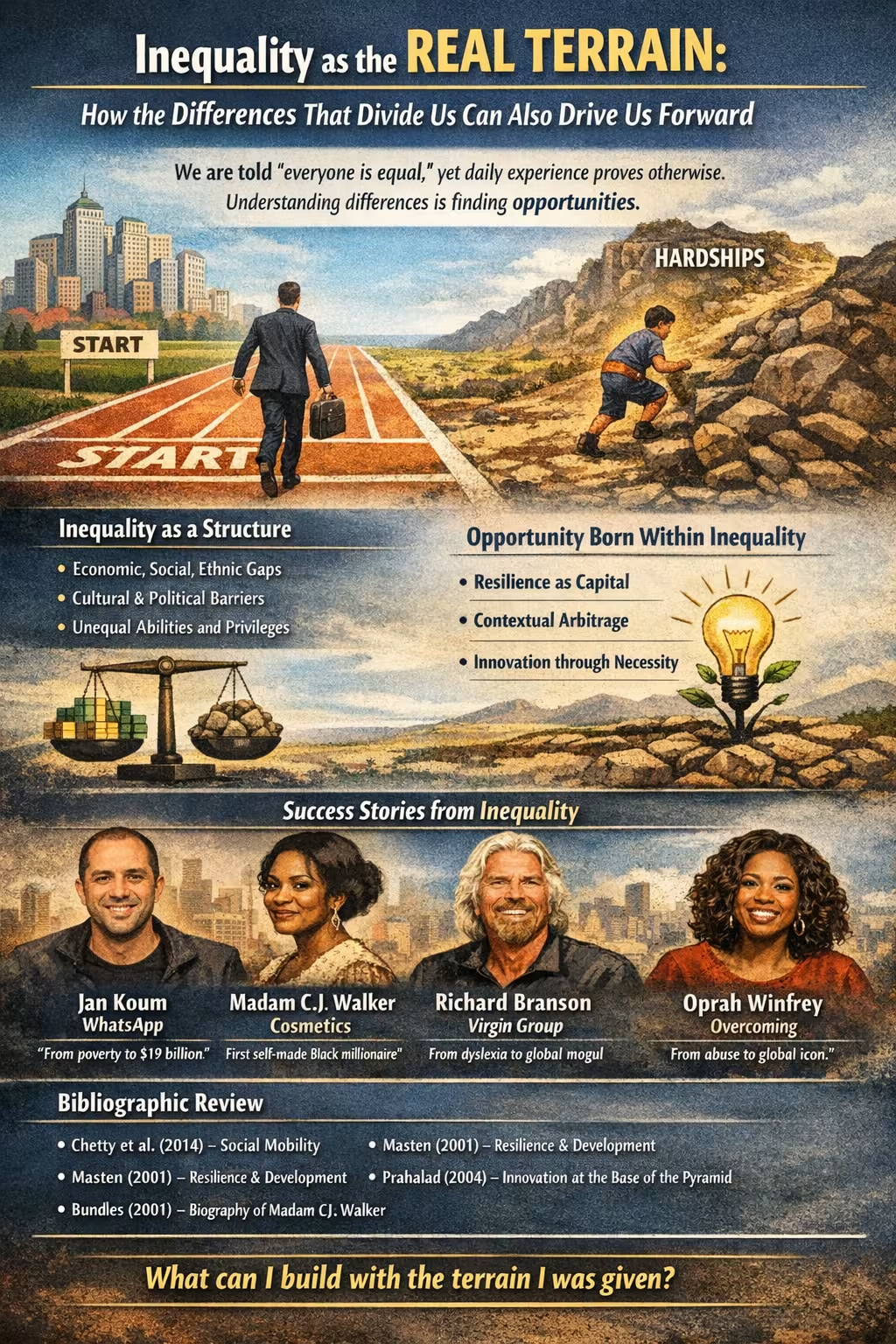
Inequality as the Real Terrain: How the Differences That Divide Us Can Also Drive Us Forward
We are told that “everyone is equal,” yet daily experience proves otherwise. Equality functions as a moral and legal ideal, not as a description of reality. Life unfolds across a landscape of asymmetries—economic, social, ethnic, political, cognitive, physical, and cultural. And while these differences may seem unjust, they also open unexpected spaces for creativity, resilience, and success.
Accepting this reality is not surrender; it is understanding the terrain in order to navigate it wisely.
Equality as Aspiration, Not as Starting Point
Three concepts are often confused:
- Equality before the law: a normative principle that is not always fulfilled in practice.
- Equality of opportunity: deeply conditioned by environment, family, economy, and politics.
- Human equality: a philosophical idea that does not erase real differences in capacity, context, or privilege.
Life is not a race with a single starting line. It is a set of tracks of different lengths, climates, and rules that change depending on who runs.
Inequality as a Structure That Shapes Human Experience
Gaps are not accidents; they are part of the social design.
- Political: unequal access to rights, representation, and justice.
- Economic: limited social mobility, concentrated wealth.
- Ethnic and cultural: discrimination, stigma, invisible barriers.
- Social: unequal support networks, environments that either propel or hinder.
- Physical and cognitive: abilities valued unequally by the system.
- Religious: beliefs that open doors in some contexts and close them in others.
Denying these differences does not erase them; it only blinds us to their impact.
The Paradox: Opportunity Is Born Within Inequality
Recognizing that we are not equal does not mean resignation—it means strategy. Differences create spaces where some can build advantages that would not exist in a perfectly symmetrical world.
Three mechanisms through which inequality becomes a driver:
- Resilience as capital: scarcity develops risk tolerance, creativity, and adaptability.
- Contextual arbitrage: what is a disadvantage in one environment can be an advantage in another.
- Innovation through necessity: lack forces different thinking, breaking molds that privilege never questions.
Real Cases Where Inequality Was the Origin of Success
Jan Koum – WhatsApp
Ukrainian immigrant raised in poverty. His need to communicate with family without high costs led him to create a lightweight, simple app. WhatsApp was sold for $19 billion.
Madam C.J. Walker – Cosmetics for Black Women
Born into extreme racial and economic exclusion. She identified an ignored market: hair care for Black women. Built an empire and became the first self‑made female millionaire in the U.S.
Richard Branson – Virgin Group
His dyslexia kept him outside the academic mold. He turned his different way of thinking into a strategic advantage that became the foundation of a global conglomerate.
Howard Schultz – Starbucks
Grew up in a working‑class neighborhood. His experience with job insecurity inspired him to create a company offering benefits to part‑time employees. Transformed a local coffee shop into a global brand.
Oprah Winfrey – Media and Leadership
Childhood marked by poverty and discrimination. Her ability to connect emotionally with audiences was born directly from her story. Today she is one of the most influential women in the world.
Final Reflection
Equality is an ethical horizon we must defend, but inequality is the real terrain where life unfolds. Those who understand that terrain stop waiting for automatic justice and begin to build strategy, identity, and purpose.
The question is not whether the world is fair.
The question is: What can I build with the terrain I was given?
Bibliographic Review (APA 7th Edition)
Structural Inequality and Social Mobility
- Chetty, R., Hendren, N., Kline, P., & Saez, E. (2014). Where is the land of opportunity? The geography of intergenerational mobility in the United States. The Quarterly Journal of Economics, 129(4), 1553–1623.
- Piketty, T. (2014). Capital in the twenty‑first century. Harvard University Press.
- Sen, A. (1992). Inequality reexamined. Harvard University Press.
- Stiglitz, J. E. (2012). The price of inequality. W. W. Norton & Company.
Resilience, Adversity, and Human Development
- Masten, A. S. (2001). Ordinary magic: Resilience processes in development. American Psychologist, 56(3), 227–238.
- Ungar, M. (2011). The social ecology of resilience. Springer.
- Rutter, M. (2012). Resilience as a dynamic concept. Development and Psychopathology, 24(2), 335–344.
Innovation from Necessity and Entrepreneurship in Adverse Contexts
- Banerjee, A. V., & Duflo, E. (2011). Poor economics: A radical rethinking of the way to fight global poverty. PublicAffairs.
- Prahalad, C. K. (2004). The fortune at the bottom of the pyramid. Wharton School Publishing.
- Sarasvathy, S. D. (2001). Causation and effectuation: Toward a theoretical shift in entrepreneurship. Academy of Management Review, 26(2), 243–263.
Biographies and Success Stories
- Branson, R. (2011). Screw business as usual. Portfolio.
- Koum, J., & Acton, B. (2014). Interviews and corporate profiles in Forbes and The Wall Street Journal.
- Bundles, A. L. (2001). On her own ground: The life and times of Madam C.J. Walker. Scribner.
- Winfrey, O. (2017). The wisdom of Sundays. Flatiron Books.
- Schultz, H. (2011). Onward: How Starbucks fought for its life without losing its soul. Rodale Books.
Comments