Failure Mode and Effects Analysis (FMEA): A Comprehensive Review of Its Evolution and Industrial Application
Abstract:
Failure Mode and Effects Analysis (FMEA) has established itself as the most robust risk prevention tool in reliability engineering. This article explores its theoretical foundation, from its military genesis to its integration into Industry 4.0 frameworks, analyzing its current capabilities and challenges.
1. What is FMEA?
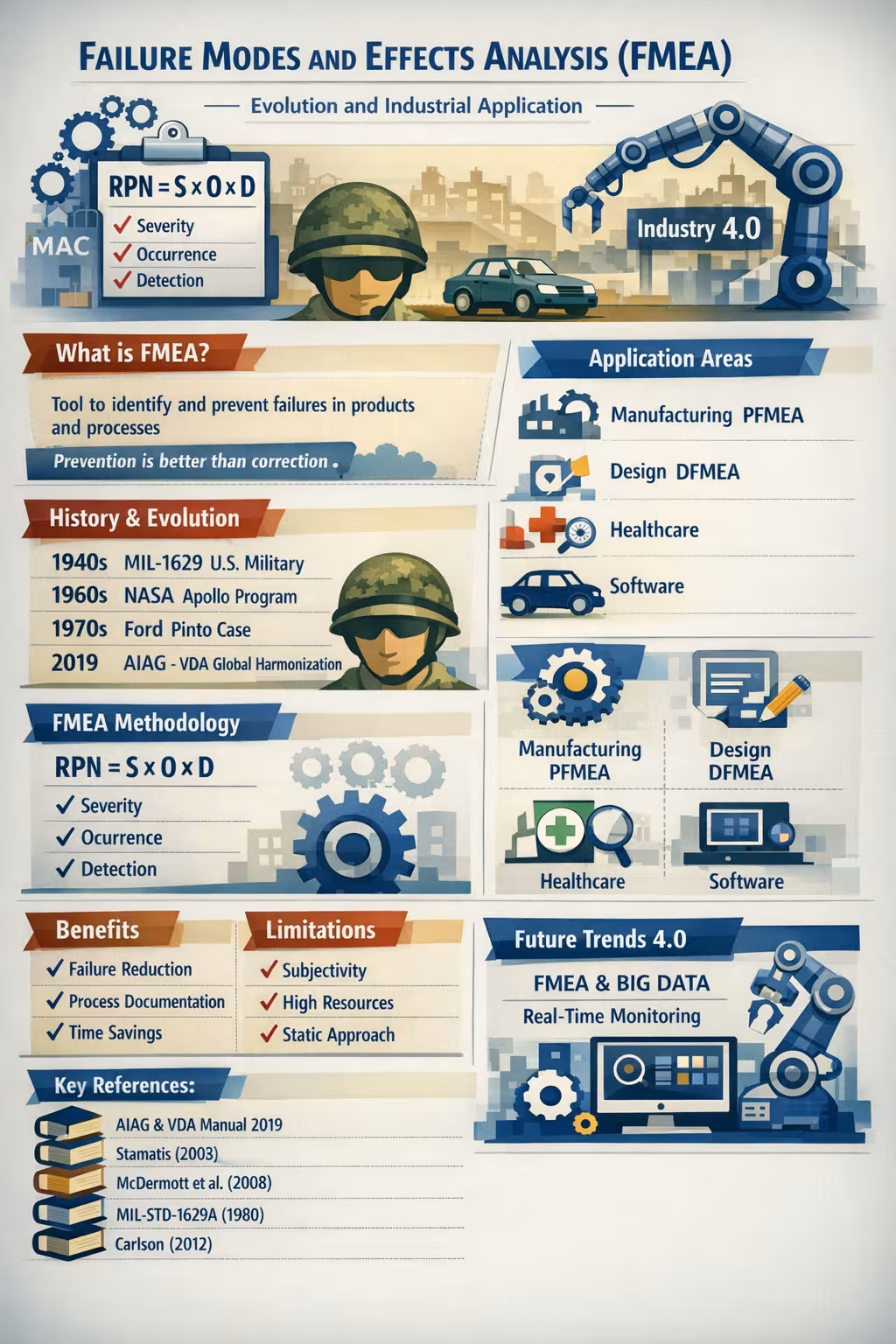
FMEA is a systematic, tabular procedure for identifying potential failure modes in a product or process. Its goal is to evaluate the causes and effects of such failures to implement preventive actions before the failure occurs. It is based on a fundamental premise: prevention is substantially more cost-effective than correction.
2. History and Evolution
The methodology was born in the 1940s within the U.S. Armed Forces under the military standard MIL-P-1629. Its initial purpose was to mitigate risks in weapons systems.
- 1960s: NASA standardized it for the Apollo program, where astronaut safety depended on a "zero-error" failure analysis.
- 1970s: Ford Motor Company introduced it to the automotive sector following the Pinto model scandal, transforming it into a civil quality standard.
- 2019: The most significant recent update occurred with the harmonization of the AIAG (USA) and VDA (Germany) manuals, unifying risk criteria for the global supply chain.
3. Methodology: The Calculation Process
The core of traditional FMEA is the calculation of the Risk Priority Number (RPN), which results from multiplying three factors rated on a scale of 1 to 10:
- Severity (S): The seriousness of the failure's effect on the customer.
- Occurrence (O): The likelihood that the cause of the failure will occur.
- Detection (D): The ability of current controls to detect the failure before it reaches the customer.
$$RPN = S \times O \times D$$
Note: Modern trends (AIAG-VDA) are replacing the RPN with Action Priorities (AP), which place greater strategic weight on Severity.
4. Fields of Application
Although it originated in mechanics, its scope is now transversal:
- Manufacturing (PFMEA): Analysis of assembly and production processes.
- Design (DFMEA): Analysis of products from the conceptual stage.
- Healthcare: Risk management in surgeries and medication administration.
- Software: Identification of critical bugs in systems development.
5. Benefits and Limitations
Benefits:
- Enhances brand image by reducing post-sale failures.
- Documents institutional knowledge about processes.
- Reduces development times by avoiding re-work.
Limitations:
- Subjectivity: Factor ratings depend heavily on the team's experience.
- Resources: Requires a considerable investment of time and multidisciplinary personnel.
- Static Nature: If not updated after a real failure, the document becomes obsolete.
6. Recommendations for Success
- Multidisciplinary Team: It should never be done by a single person; it must include experts in quality, design, production, and maintenance.
- Action-Oriented: An FMEA without a corrective action plan is merely a bureaucratic exercise.
- Prioritization: Focus first on failures with Severity 9 and 10, regardless of their total RPN.
7. Future Trends
FMEA 4.0 points toward integration with Big Data. The use of real-time sensors will allow occurrence tables to update automatically via Machine Learning algorithms, evolving from a static document into a dynamic early-warning system.
Bibliographic Review
- AIAG & VDA. (2019). FMEA Handbook. 1st Edition. (The definitive technical reference for today's industry).
- Stamatis, D. H. (2003). Failure Mode and Effect Analysis: FMEA from Theory to Execution. ASQ Quality Press. (The most complete academic text on the methodology).
- McDermott, R. E., Mikulak, R. J., & Beauregard, M. R. (2008). The Basics of FMEA. Productivity Press. (Ideal for understanding practical implementation).
- MIL-STD-1629A. (1980). Procedures for Performing a Failure Mode, Effects and Criticality Analysis. Department of Defense. (Base historical document for FMECA).
- Carlson, C. S. (2012). Effective FMEAs: Achieving Safe, Reliable, and Economical Products and Processes using Failure Mode and Effects Analysis. Wiley. (Focuses on team management and organizational culture).
Comments