Troubleshooting: Theory, Methodology, and the Science of Technical Problem Solving
Abstract:
Troubleshooting is a systematic form of problem-solving aimed at identifying the root cause of failures in products or processes. This article reviews its logical structure, its evolution from simple mechanics to complex digital systems, and the trends transforming this art into a predictive science.
1. What is Troubleshooting?
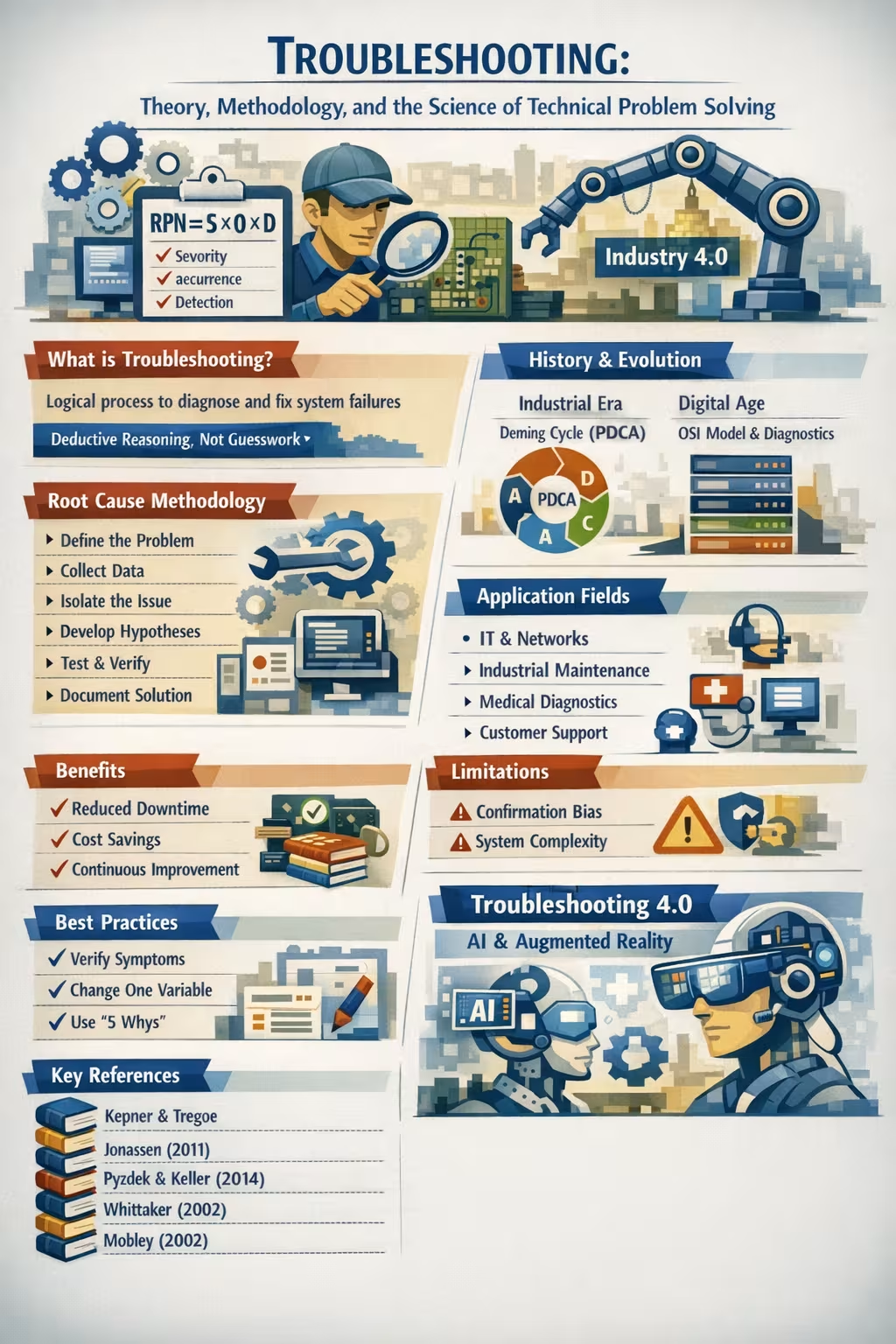
Troubleshooting is a logical and systematic process used to diagnose and repair faults in complex systems (mechanical, electronic, software, or procedural). Unlike "trial and error" repair, troubleshooting employs deductive reasoning to isolate the specific component or process preventing the system from functioning correctly.
2. Historical Perspective
The term emerged in the late 19th century with the deployment of telegraph and railroad lines. Initially, it was a purely physical task of "patrolling the lines" in search of issues.
- Industrial Era: With the rise of mass production, methods like the Deming Cycle (PDCA) were formalized to address quality issues.
- Digital Era: The complexity of computing systems in the 70s and 80s led to structured diagnostic protocols, such as the OSI model for networks, which segments problems by layers.
3. Methodology: The Path to Root Cause
While several variations exist, the standard process follows these steps:
- Problem Definition: Identify symptoms and the "desired state" vs. the "current state."
- Data Collection: Observation, error logs, and interviews with operators.
- Problem Isolation: Use of the "Divide and Conquer" method (eliminating sections of the system that are working correctly).
- Hypothesis Development: Proposing possible causes based on evidence.
- Testing and Verification: Implementing a solution and verifying if the problem persists.
- Documentation: Recording the solution to prevent recurrence (Knowledge Base).
4. Fields of Application
- IT and Networking: Diagnosis of connectivity, latency, and code errors.
- Industrial Maintenance: Repair of CNC machinery, hydraulic systems, and motors.
- Medicine: Medical differential diagnosis is, in essence, a biological troubleshooting process.
- Customer Service: Resolution of end-user technical incidents.
5. Benefits and Limitations
Benefits:
- MTTR Reduction: Decreases the Mean Time To Repair.
- Cost Savings: Prevents the unnecessary replacement of functional components.
- Continuous Improvement: Feeds quality systems (like FMEA) to redesign failing parts.
Limitations:
- Confirmation Bias: Technicians often look for evidence that confirms their initial suspicion, ignoring other possibilities.
- Systemic Complexity: In highly interconnected systems, a failure may have multiple causes (non-linear causality).
6. Recommendations and Best Practices
- Assume Nothing: Personally verify symptoms before diagnosing.
- Change One Variable at a Time: If you change two things and the problem is resolved, you won't know which one was the actual cause.
- Use the "5 Whys": A Toyota technique to drill down until reaching the root of the problem.
7. Trends: Troubleshooting 4.0
The future lies in AI-Assisted Troubleshooting. Through Machine Learning algorithms and IoT sensors, systems can now perform "self-diagnosis" or guide human technicians using Augmented Reality (AR), overlaying repair instructions onto the physical equipment.
Bibliographic Review
- Kepner, C. H., & Tregoe, B. B. (1997). The New Rational Manager. Princeton Research Press. (A classic work on problem-solving and decision-making).
- Jonassen, D. H. (2011). Learning to Solve Problems: A Handbook for Designing Problem-Solving Learning Environments. Routledge. (Analyzes the psychology behind technical diagnosis).
- Pyzdek, T., & Keller, P. (2014). The Six Sigma Handbook. McGraw-Hill Education. (Provides statistical tools applied to process diagnosis).
- Whittaker, J. A. (2002). How to Break Software: A Practical Guide to Testing. Addison-Wesley. (Specific to troubleshooting and debugging in computer systems).
- Mobley, R. K. (2002). An Introduction to Predictive Maintenance. Elsevier. (Explains how troubleshooting evolves into proactive prevention).
Comments