The Dreyfus Model of Skills Acquisition: A Roadmap for Developing High‑Performing Teams
Understanding how team members develop skills is essential for building high‑performing, self‑organizing teams. While many leaders rely on intuition to assess capability, a structured framework can dramatically improve how they support growth, allocate responsibilities, and design learning pathways. The Dreyfus Model of Skills Acquisition, developed by brothers Stuart and Hubert Dreyfus, offers exactly such a framework—a clear progression from novice to expert that applies to any skill domain.
Understanding the Five Stages of Skill Development
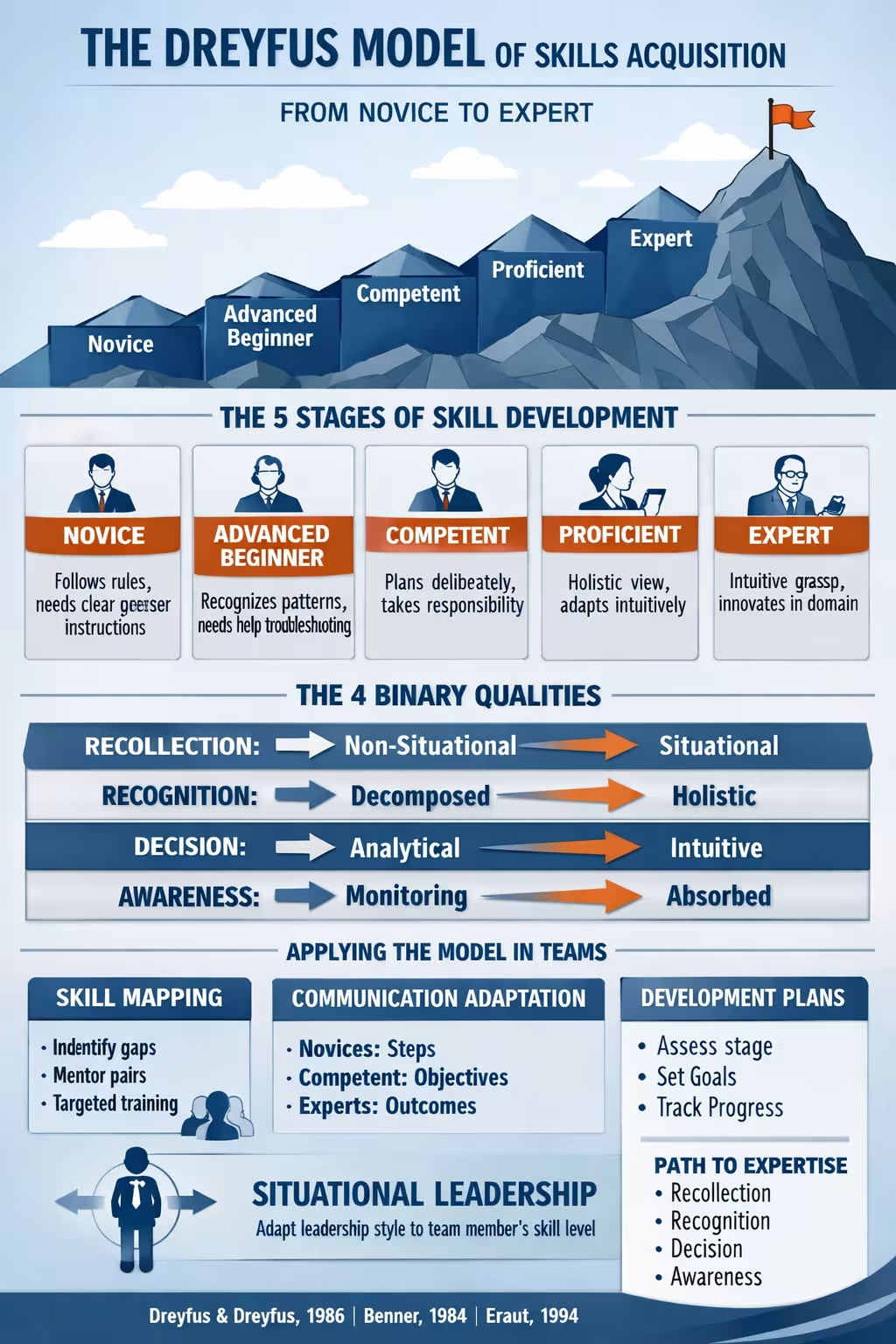
The Dreyfus Model outlines five distinct stages that describe how individuals evolve from rule‑dependent beginners to intuitive experts. Unlike simpler three‑stage models such as Shu‑Ha‑Ri, the Dreyfus framework provides finer granularity and deeper insight into cognitive transformation.
Stage 1 — Novice
At the novice stage, individuals rely entirely on rules and explicit instructions.
Characteristics:
- Rigid adherence to taught rules or plans
- No discretionary judgment
- Dependence on clear, step‑by‑step instructions
- Limited understanding of context or purpose
- Focus on correctness rather than outcomes
Team Example:
A new developer who can follow coding standards when given explicit instructions but struggles with ambiguity or exceptions.
Stage 2 — Advanced Beginner
Advanced beginners begin to recognize recurring patterns but still lack the ability to prioritize.
Characteristics:
- Limited situational perception
- Treat all aspects of work as equally important
- Recognition of recurring elements
- Beginning to apply guidelines in context
- Still require support for troubleshooting
Team Example:
A product team member who can write basic user stories using templates but cannot yet distinguish high‑value features from low‑value ones.
Stage 3 — Competent
Competence marks a major shift toward autonomy and responsibility.
Characteristics:
- Makes deliberate choices despite uncertainty
- Manages multiple activities and information sources
- Understands actions in relation to long‑term goals
- Plans work intentionally
- Develops routines for efficiency
- Takes responsibility for outcomes
Team Example:
A quality engineer who creates comprehensive test plans, prioritizes critical cases, and adapts strategies based on risk and deadlines.
Stage 4 — Proficient
Proficient performers see situations holistically and adjust their approach intuitively.
Characteristics:
- Learns from the experience of others
- Recognizes patterns and deviations holistically
- Prioritizes effectively
- Uses maxims that adapt to each situation
- Self‑corrects when approaching problems incorrectly
Team Example:
A senior analyst who immediately spots anomalies in data and guides junior colleagues through complex analytical challenges.
Stage 5 — Expert
Experts operate from deep tacit knowledge and intuitive understanding.
Characteristics:
- Recognized as go‑to resources
- Minimal reliance on rules or guidelines
- Intuitive grasp of situations
- Ability to envision possibilities beyond conventional approaches
- Uses analytical reasoning only when facing novel problems
- Innovates within their domain
Team Example:
A technical architect who envisions elegant solutions to complex problems and makes intuitive design decisions that later prove optimal.
The Four Binary Qualities That Drive Development
The Dreyfus Model identifies four cognitive transformations that evolve across the five stages:
1. Recollection: Non‑situational → Situational
- Beginners recall rules independent of context
- Advanced performers recall information relevant to the specific situation
2. Recognition: Decomposed → Holistic
- Early stages break tasks into parts
- Proficient and expert performers perceive patterns holistically
3. Decision: Analytical → Intuitive
- Beginners rely on deliberate analysis
- Experts make intuitive decisions based on tacit knowledge
4. Awareness: Monitoring → Absorbed
- Beginners monitor their performance closely
- Experts become absorbed in the task, focusing on strategy rather than mechanics
These shifts illustrate that expertise is not simply “more knowledge,” but a fundamentally different way of perceiving and acting.
Applying the Dreyfus Model in Team Environments
1. Skill Mapping Across Team Members
Teams often contain individuals at different stages for different skills. Mapping these levels helps leaders:
- Identify capability gaps
- Create effective mentoring pairs
- Allocate work appropriately
- Design targeted training plans
2. Adapting Communication to Skill Level
Misalignment between communication style and skill level is a major source of friction.
- Novices: need step‑by‑step instructions
- Advanced Beginners: need guidelines with context
- Competent performers: need objectives and autonomy
- Proficient members: need the big picture and constraints
- Experts: need only the problem and desired outcome
3. Creating Development Plans
The Dreyfus Model supports structured growth through:
- Assessment of current stage
- Goal setting
- Tailored support
- Progress tracking
- Recognition of milestones
Dreyfus and Situational Leadership
The Dreyfus Model provides the cognitive foundation for Situational Leadership, which argues that leaders must adapt their style based on the development level of their team members. Understanding where someone sits on the Dreyfus scale enables leaders to choose the right balance of direction, coaching, support, and autonomy.
Conclusion
The Dreyfus Model of Skills Acquisition is a powerful tool for leaders, educators, and organizations seeking to develop talent strategically. By understanding how individuals progress from novice to expert, teams can improve communication, accelerate learning, and unlock higher levels of performance and innovation.
References
- Benner, P. (1984). From Novice to Expert: Excellence and Power in Clinical Nursing Practice. Addison‑Wesley.
- Dreyfus, H. L., & Dreyfus, S. E. (1986). Mind Over Machine: The Power of Human Intuition and Expertise in the Era of the Computer. Basil Blackwell.
- Dreyfus, S. E. (1981). Four Models of Human Situational Understanding. U.S. Air Force Office of Scientific Research.
- Eraut, M. (1994). Developing Professional Knowledge and Competence. Falmer Press.
- Wikipedia contributors. Dreyfus Model of Skill Acquisition.
Comentarios