Commissioning and Start-up of Process Units: Engineering, Organization, and Operational Execution
Abstract
Commissioning and start-up represent the critical transition between construction and industrial operation. They are the point where engineering, safety, reliability, and operational performance converge. This article synthesizes the principles, stages, responsibilities, and best practices for commissioning process units, drawing from specialized technical documentation and historical standards such as API 700. A brief literature review contextualizes the evolution of commissioning methodologies in the energy and process industries.
1. Introduction
Commissioning and start-up are the bridge between design and operational reality. Although often perceived as the final step of construction, they are in fact the decisive phases that determine the safety, quality, reliability, cost, and schedule performance of the entire project.
The source document identifies three main types of start-up:
- New units
- Restart after maintenance shutdowns
- Restart of units kept in circulation or blocked-in
In all cases, early preparation is essential: “These activities must be prepared well in advance, long before construction is completed.”
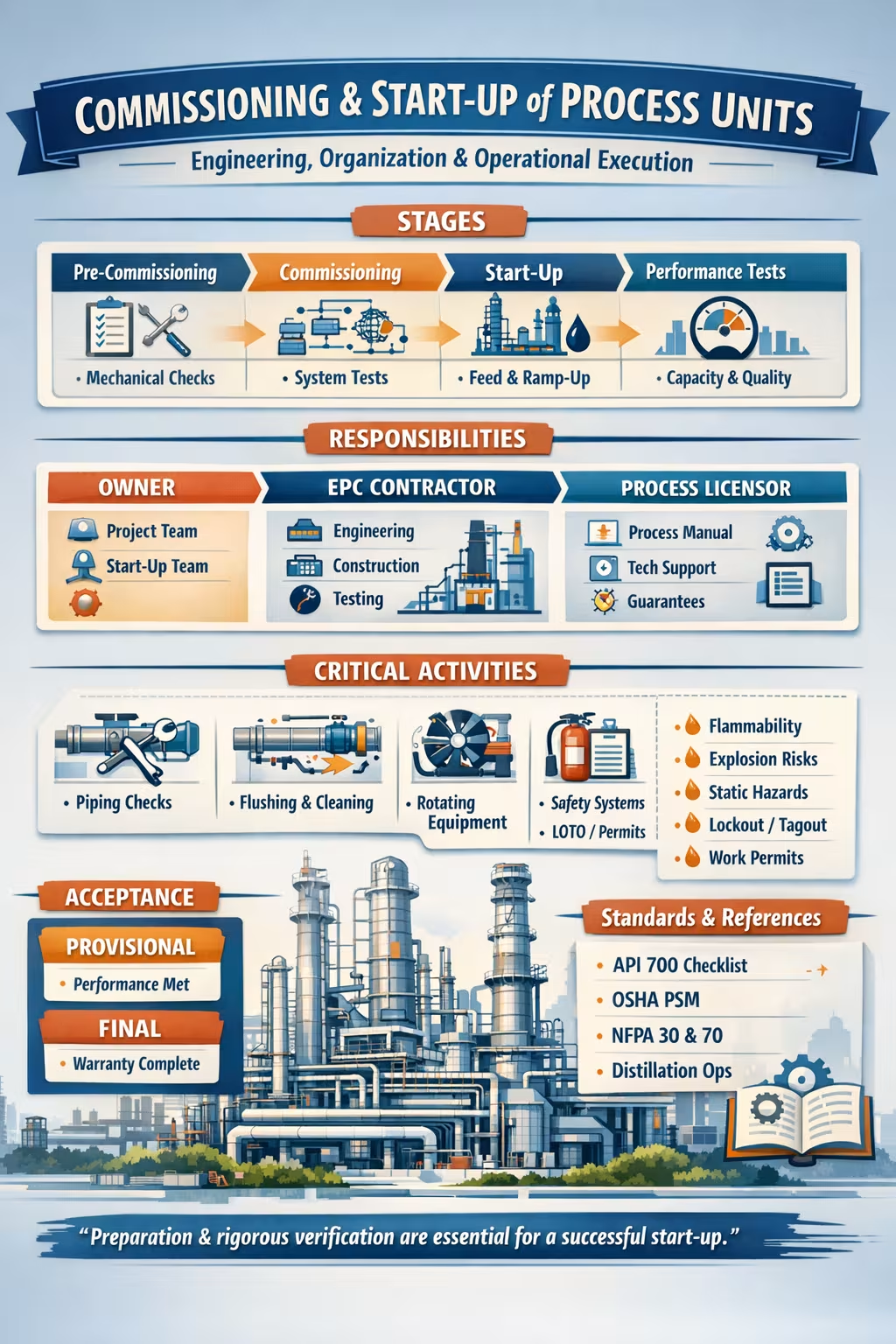
2. Commissioning and Start-up Stages
2.1 Pre-commissioning
This phase includes mechanical verifications and non-operational adjustments. It ensures that the installation conforms to engineering specifications.
Typical activities:
- Hydrostatic tests
- Verification of supports, guides, anchors, and thermal expansion
- Inspection of valves, drains, vents, and line routing
- Initial cleaning (water, air, chemical)
The document defines it as “mechanical verifications, non-operational adjustments, and cold alignments performed by the contractor.”
2.2 Commissioning
This is the operational preparation phase prior to start-up. It includes energization, dynamic tests, utility introduction, and control loop verification.
Key activities:
- Utility introduction
- Catalyst and chemical loading
- Inert fluid testing
- Instrument loop checks
- Safety system testing
- Leak testing
- Inerting and purging
Completion of this phase leads to the “ready-for-start-up declaration.”
2.3 Start-up
Start-up begins with the introduction of feedstock (oil-in). Process variables are gradually increased until stable conditions and on-spec products are achieved.
The document states:
“Start-up begins with the introduction of raw materials… until stable conditions and on-spec products are obtained.”
2.4 Performance Guarantee Tests
These tests validate:
- Production capacity
- Product quality
- Energy and raw material consumption
- Emissions
- Noise levels
- Operational stability
2.5 Provisional and Final Acceptance
- Provisional acceptance: granted after performance guarantees are met.
- Final acceptance: granted after the mechanical warranty period.
3. Roles and Responsibilities
3.1 Owner
Organized into:
- Project team
- Start-up team
Responsibilities include:
- Oversight of safety, quality, and schedule
- Mechanical acceptance of systems
- Operation during tests and start-up
3.2 EPC Contractor
Responsible for:
- Engineering, procurement, and construction
- Technical documentation
- Shop tests
- Technical assistance during commissioning
- Replacement of defective parts during warranty
3.3 Process Licensor
Provides:
- Process manual
- Performance guarantees
- Technical assistance during start-up
- Validation of performance tests
4. Critical Commissioning Activities
4.1 Piping and Static Equipment Verification
The document provides a detailed checklist, including:
- “Line routing, diameters, thicknesses, materials, flanges, gaskets, bolts, and torque.”
- “All low points with drains and high points with vents.”
- “Verification of supports, guides, anchors, and expansion.”
4.2 Cleaning, Flushing, and Blowing
Proper cleaning is essential to avoid early failures:
“Plants placed in service without thorough cleaning will soon suffer obstructions, valve damage, and destruction of moving parts.”
Methods include:
- Water flushing
- Air or steam blowing
- Chemical cleaning
- Hydrocarbon flushing
4.3 Rotating Equipment
Activities include:
- Rotation tests
- Cold and hot alignment
- Lubrication verification
- Vibration and trip testing
4.4 Critical Equipment
- Heaters and furnaces
- Distillation columns
- Reactors
- Heat exchangers
- Vacuum systems
- Safety systems (PSV, SIS)
5. Safety in Commissioning
The document dedicates extensive sections to safety, including:
- Flammability
- Explosive limits
- Minimum ignition energy
- Static electricity hazards
- Lockout/tagout procedures
- Work permit systems
A key statement:
“The risks during start-ups and shutdowns require a strict quality control system and updated procedures.”
6. Commissioning Organization
6.1 System and Subsystem Breakdown
Essential to avoid overloading the commissioning team and to enable progressive acceptance.
6.2 Execution Plan
Includes:
- Operating manual
- Start-up sequences
- Responsibility matrix
- Human and material resources
- Detailed schedule
- Document control
6.3 Commissioning Team
Typically includes:
- Commissioning manager
- Process engineers
- Field and panel operators
- Mechanical, electrical, and instrumentation specialists
- Licensor representatives
- Equipment vendors
7. Conclusions
Commissioning is not a final administrative step—it is a technical discipline that determines the future reliability of the plant. Success depends on:
- Early preparation
- Clear responsibilities
- Rigorous verification
- Thorough cleaning and testing
- Impeccable documentation
- Integration between project, operations, and licensor
As the document emphasizes:
“Continuous improvement requires a strict control system to maintain and update existing procedures.”
8. Bibliographic Review
8.1 Standards and Technical Guidelines
- API 700 – Checklist for Plant Completion (1981)
- API RP 1FSC – Facility Commissioning
- ISA 7.1 – Pneumatic Control Circuit Pressure Test
- NFPA 30 and 70
- OSHA 1910.119 – Process Safety Management
8.2 Academic and Technical Literature
- Kister, H. Z. Distillation Operations.
- Bloch, H. P. Pump User’s Handbook.
- Lipták, B. Instrument Engineers’ Handbook.
- Smith, R. Chemical Process Design and Integration.
8.3 Source Document Citations
Examples of integrated citations:
- “Start-up begins with the introduction of raw materials…”
- “Mechanical verifications and cold alignments…”
- “Plants placed in service without thorough cleaning…”
Comentarios