The True Trend of Professional Careers: Beyond the Manager and the Advisor
Abstract
For decades, the dominant professional aspiration was to reach a managerial position. However, organizational transformation, digitalization, and the increasing complexity of productive systems have reshaped career paths. This article analyzes current trends, distinguishing between the managerial route, the expert advisory route, the architectural systems route, and the growing independent path based on reputation and value creation. It outlines the affinities, competencies, and responsibilities associated with each trajectory, as well as the global trends driving the diversification of professional roles.
1. Introduction
The idea that “becoming a manager” represents the pinnacle of a professional career remains deeply rooted in traditional thinking. Yet, changes in organizational structures, automation, and the need for specialized knowledge have created new development routes that depend not on hierarchy but on the type of influence a professional seeks to exert.
Today, careers are no longer linear. Organizations increasingly value individuals capable of solving complex problems, designing systems, transferring knowledge, and generating cross‑functional impact. In this context, the relevant question shifts from “What position do I want?” to “What kind of value do I want to create?”
2. The Managerial Route: Leading People and Operations
The managerial route remains essential, but its nature has evolved. It is no longer about supervising tasks; it is about managing human, cultural, and operational complexity.
Key Competencies
- Team leadership
- Conflict management
- Executive communication
- Decision‑making under pressure
- Operational discipline and compliance
Advantages
- Formal authority
- Internal visibility
- Structural influence
Challenges
- High political exposure
- Limited time for technical work
- Increasing emotional demands
Recent literature highlights that modern managers must balance technical, social, and cognitive skills to navigate volatile environments (World Economic Forum, 2023).
3. The Expert Advisory Route: Authority Based on Knowledge
A second major trend is the consolidation of the expert track, where professionals become technical, methodological, or strategic references.
Key Competencies
- Deep technical mastery
- Systems thinking
- Diagnostic capability
- Teaching and knowledge transfer
- Continuous learning
Advantages
- High autonomy
- Lower political exposure
- Cross‑functional impact
Challenges
- Requires strong reputation
- Demands constant updating
Studies emphasize that experts are essential for innovation and organizational standardization (Davenport & Kirby, 2016).
4. The Architectural Route: Designing Systems, Standards, and Methodologies
One of the most relevant—and least understood—trends is the rise of the organizational architect, responsible for designing frameworks, platforms, methodologies, and work ecosystems.
Key Competencies
- Conceptual thinking
- Process and system design
- Integration of culture, technology, and operations
- Clear and structured documentation
- Long‑term vision
Advantages
- Deep organizational impact
- Creation of long‑lasting standards
- Influence without formal authority
Challenges
- Requires professional maturity
- Demands strategic vision and patience
Authors such as Senge (2006) and Nonaka & Takeuchi (1995) highlight the importance of individuals who design learning and knowledge systems within organizations.
5. The Independent Route: Reputation, Content, and Solutions
The rise of digital platforms, the knowledge economy, and the demand for specialized training have accelerated a fourth route: professional independence.
This includes:
- Boutique consultants
- Technical content creators
- Course and certification designers
- Authors and instructors
- Educational or methodological solution architects
Key Competencies
- Effective communication
- Personal brand development
- Product or service design
- Basic commercial management
- Editorial consistency
Advantages
- Creative freedom
- Scalability
- Global impact
Challenges
- Variable income
- Requires strategy and discipline
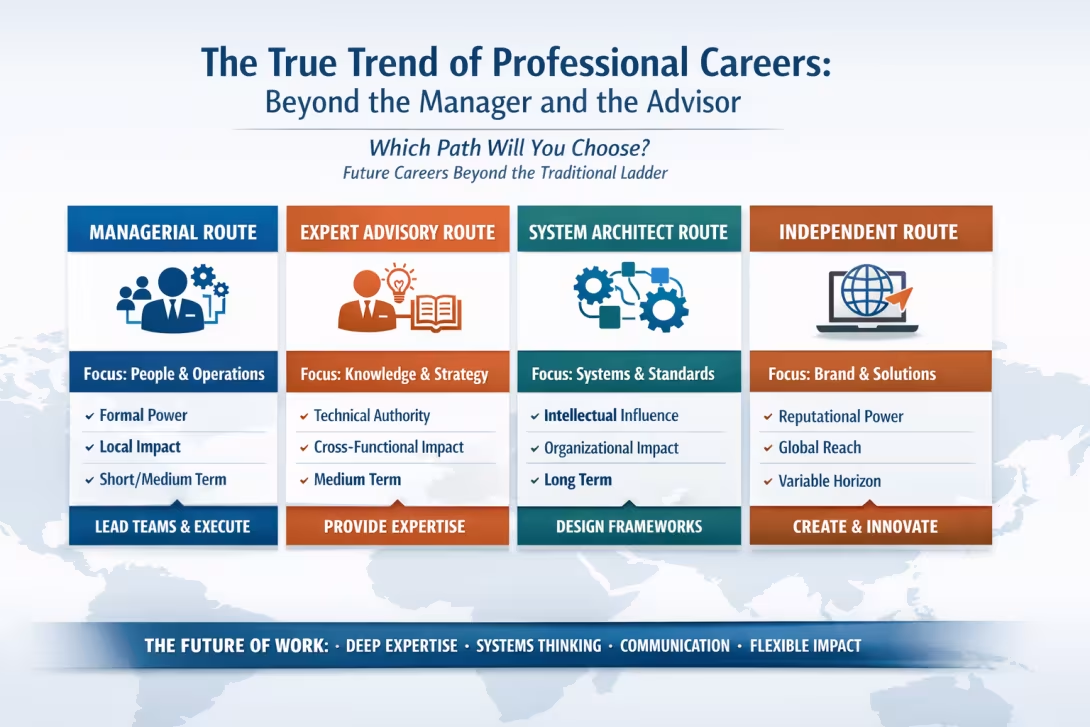
6. Comparison of Professional Routes
| Route | Focus | Type of Power | Impact | Time Horizon |
|---|---|---|---|---|
| Managerial | People and operations | Formal | Local | Short/medium term |
| Expert Advisory | Knowledge and judgment | Technical | Cross‑functional | Medium term |
| Architectural | Systems and standards | Intellectual | Organizational | Long term |
| Independent | Brand and solutions | Reputational | Global | Variable |
7. Global Trends: Toward Hybrid Roles
Evidence shows that organizations increasingly seek professionals who combine:
- Deep expertise
- Strategic thinking
- System‑design capability
- Communication and teaching skills
- Influence without formal authority
The future belongs to those who integrate expertise + design + communication + systemic vision.
8. Conclusion
A professional career is no longer a ladder but a map. Becoming a manager is only one possible route—neither the only one nor necessarily the most relevant. Expert advisory, organizational architecture, and independent professional practice represent solid, growing paths aligned with the demands of the twenty‑first century.
The key is not to pursue a title but to define the type of impact one wants to generate and develop the competencies that make that impact possible.
References (APA)
Davenport, T. H., & Kirby, J. (2016). Only humans need apply: Winners and losers in the age of smart machines. Harper Business.
Nonaka, I., & Takeuchi, H. (1995). The knowledge‑creating company: How Japanese companies create the dynamics of innovation. Oxford University Press.
Senge, P. (2006). The fifth discipline: The art and practice of the learning organization (Revised ed.). Doubleday.
World Economic Forum. (2023). The Future of Jobs Report 2023. World Economic Forum.
Comentarios