The 5 Whys Analysis: History, Methodology, Applications, and Current Relevance
Executive Summary
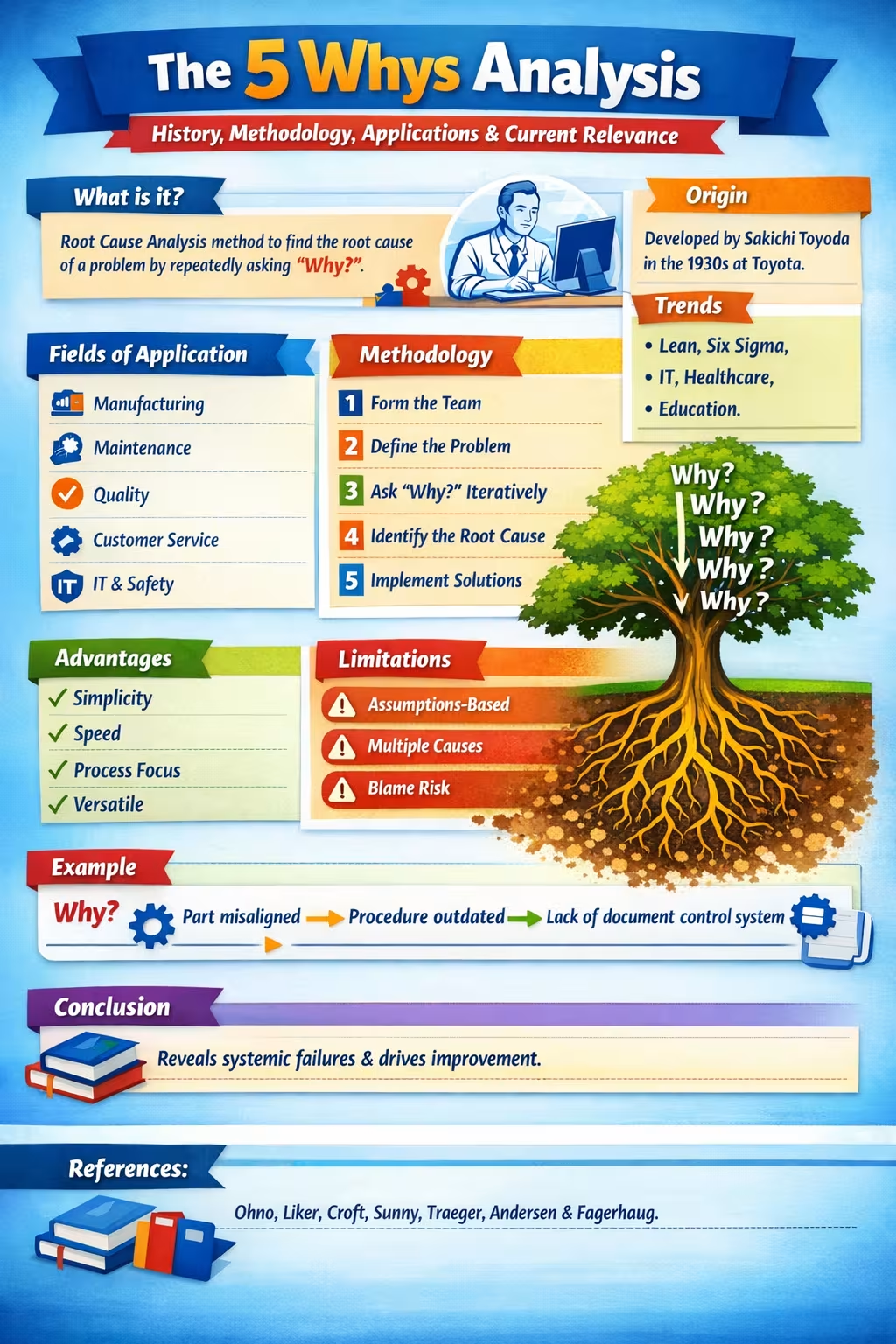
The 5 Whys Analysis is a Root Cause Analysis (RCA) technique that seeks to identify the underlying cause of a problem by repeatedly asking “Why?”. Its simplicity, speed, and ability to uncover systemic failures have made it a cornerstone tool in Lean Manufacturing, Six Sigma, quality management, maintenance, services, and operations.
1. What Is the 5 Whys Analysis?
The 5 Whys is an iterative method used to determine the root cause of a problem through a logical sequence of “Why?” questions. Although five is the typical number, the process may require more or fewer iterations depending on complexity.
Its main purpose is to avoid superficial solutions and direct efforts toward eliminating the problem permanently.
2. Origin and Historical Evolution
- 1930s: Developed by Sakichi Toyoda, founder of Toyota Industries.
- 1970s: Became a key component of the Toyota Production System (TPS) and Lean thinking.
- 21st century: Integrated into methodologies such as Lean Six Sigma, DMAIC, Kaizen, and continuous improvement programs across industries.
Current Trends
- Combined with visual tools like Ishikawa diagrams, A3 reports, and Value Stream Mapping.
- Embedded in digital RCA platforms and incident management software.
- Applied in non-industrial sectors: healthcare, education, IT, logistics, and customer service.
- Increasing focus on process failures rather than individual blame.
3. Fields of Application
The 5 Whys Analysis is highly versatile and used in:
- Manufacturing and production: recurring defects, equipment failures, variability.
- Maintenance and reliability: failure analysis, operational incidents.
- Quality and continuous improvement: nonconformities, deviations, audits.
- Customer service: recurring complaints, response delays.
- Information technology: repetitive bugs, service interruptions.
- Industrial safety: incidents, near misses, operational deviations.
- Administrative management: delays, documentation errors, coordination failures.
4. Methodology of the 5 Whys Analysis
Step 1. Form the right team
Include people familiar with the process, those who observed the problem, or those affected by it. Assign a facilitator.
Step 2. Clearly define the problem
Write a precise, verifiable, and agreed-upon statement.
Step 3. Ask “Why?” iteratively
- Each answer must be based on data, not assumptions.
- Use a single-line 5 Whys (linear) or a multi-branch 5 Whys (for multiple possible causes).
Step 4. Identify the root cause and propose countermeasures
Solutions must be practical, sustainable, and process-oriented.
Step 5. Implement and monitor
Verify the effectiveness of countermeasures and repeat the analysis if the problem persists.
5. Conceptual Example
A recurring equipment defect may lead to causes such as:
- Why did the defect occur? → The part was misaligned.
- Why was it misaligned? → The operator didn’t follow the procedure.
- Why didn’t the operator follow the procedure? → It was outdated.
- Why was it outdated? → There’s no periodic review process.
- Why is there no review process? → Lack of a document management system.
The root cause is not the operator but a systemic management failure.
6. Advantages of the 5 Whys Analysis
- Simplicity: requires no advanced statistical tools.
- Speed: can be completed in minutes.
- Efficiency: uncovers deep causes with minimal effort.
- Process focus: reduces the tendency to blame individuals.
- Versatility: applicable across industries.
- Complementarity: integrates easily with other RCA methods.
7. Limitations and Risks
- Superficiality if not data-driven: may lead to wrong conclusions.
- Facilitator bias: quality depends on team experience.
- Multiple causes: not all problems have a single root cause.
- Risk of blame: if misused, may focus on human error instead of process failure.
- Not a substitute for complex methods: critical failures may require FMEA, HAZOP, Ishikawa, or statistical analysis.
8. Conclusions
The 5 Whys Analysis remains an essential tool in modern operations, quality, and reliability management. Its value lies in its ability to reveal systemic weaknesses, promote continuous improvement, and strengthen a process-oriented organizational culture. In an increasingly complex world, its simplicity becomes a strategic advantage.
9. References (APA 7)
- Croft, D. (2026). How to Perform a 5 Whys Analysis: Step-by-Step Guide. Lean Six Sigma Resources.
- Sunny, S. (2025). 5 Whys – Six Sigma Study Guide. Six Sigma Study Guide.
- Traeger, S. (2025). 5 Whys Technique: Simple Steps to Find Real Problems. Reliability Articles.
- Ohno, T. (1988). Toyota Production System: Beyond Large-Scale Production. Productivity Press.
- Liker, J. (2004). The Toyota Way. McGraw-Hill.
- Andersen, B., & Fagerhaug, T. (2006). Root Cause Analysis: Simplified Tools and Techniques. ASQ Quality Press.
Comentarios