Critical Asset Management Program: Methodology for Identifying and Tracking “Bad Actors” in Petroleum Refining
Technical Review Article
Industrial Reliability and Maintenance Area
Abstract
Efficient management of industrial assets in oil refineries requires systematic methodologies to identify and prioritize equipment that poses the highest operational risks and maintenance costs. This article examines the Bad Actors Program, a reliability strategy widely adopted in the hydrocarbon industry that focuses engineering resources on a limited number of assets with chronic and costly failures. It summarizes classification criteria for rotating equipment, pressure safety valves (PSVs), heat exchangers, instrumentation, piping, and fixed equipment, along with performance indicators, data sources, and reporting mechanisms. Published implementation results show significant medium‑ and long‑term improvements in reliability indicators and a more efficient distribution of technical resources.
Keywords: equipment reliability, bad actors, asset management, MTBF, oil refinery, industrial maintenance.
1. Introduction
Oil refining facilities operate large networks of interconnected equipment whose performance directly affects operational continuity, process safety, and profitability. Within these assets, a small subset typically accounts for a disproportionate share of failures, corrective maintenance costs, and unplanned shutdowns.
The Bad Actors Program emerges as a methodological response to this reality, recognizing that indiscriminate allocation of engineering resources is inefficient compared with a focused approach targeting high‑impact assets. This aligns with the Pareto principle, where roughly 20% of equipment generates 80% of failure‑related costs.
This article consolidates the foundations, classification criteria, and monitoring indicators used in this methodology, providing a replicable reference framework for engineers and maintenance managers seeking to structure or enhance their asset reliability programs.
2. Conceptual Framework
2.1 Definition of a Bad Actor
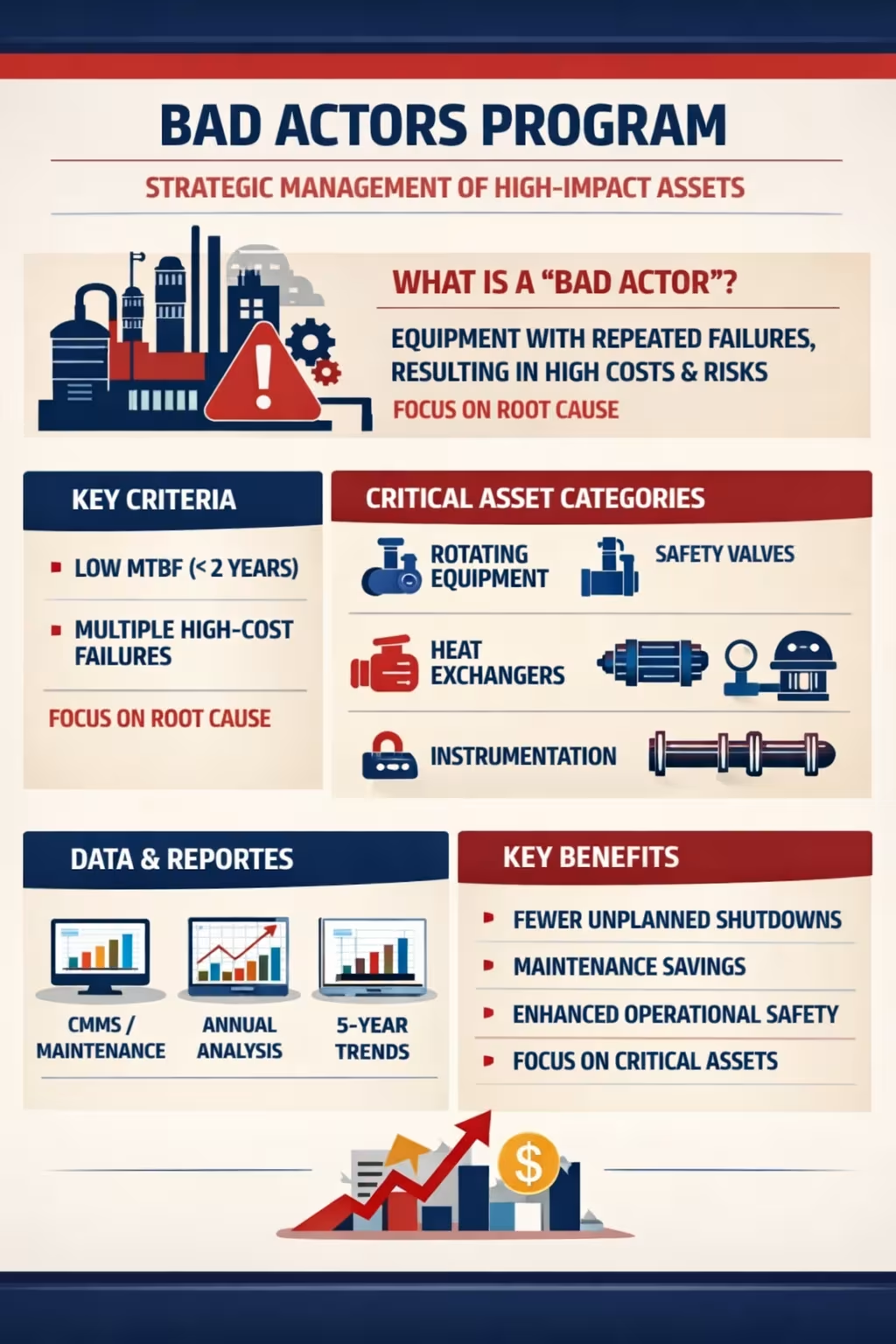
A Bad Actor is an industrial asset that repeatedly exhibits failures with significant economic, operational, or safety consequences. Unlike isolated high‑impact events (“Big Hitters”), Bad Actors are characterized by chronic and recurring failure patterns, identifiable through historical tracking.
This distinction is essential for intervention strategy: Bad Actors require root‑cause‑oriented solutions, while isolated major events may be addressed through design improvements or equipment replacement.
2.2 Mean Time Between Failures (MTBF) as a Central Indicator
The Mean Time Between Failures (MTBF) is the primary quantitative indicator in reliability programs. Its standardized calculation for rotating equipment, instrumentation, and control valves enables objective thresholds for classifying assets as Bad Actors and ensures comparability across units, plants, and time periods.
3. Asset Categories and Classification Criteria
3.1 Rotating Equipment
Includes pumps, electric motors, turbines, reciprocating and centrifugal compressors, and fin‑fan coolers.
Typical classification criteria:
- Two or more failures within 12 consecutive months, and
- Associated maintenance cost above a predefined threshold (commonly around USD 20,000)
This dual criterion—frequency and cost—prevents over‑classification of minor recurring failures and avoids excluding high‑cost, low‑frequency events.
Common failure modes include mechanical seal failures, bearing failures, coupling failures, electrical faults, valve fouling in compressors, and auxiliary component failures.
3.2 Pressure Safety Valves (PSVs)
PSVs are critical for process safety. Classification as Bad Actors is based on functional performance:
- More than three tests in the reference period
- Failure rate above 50%, including leaking, sticking, or failure to open at set pressure
3.3 Heat Exchangers
Classification is based solely on repair frequency:
- Two or more repairs of any type within three consecutive years
This reflects the inherently high cost of exchanger repairs, regardless of individual intervention cost.
3.4 Instrumentation and Control Valves
Assets with MTBF below two years are automatically classified as Bad Actors and reviewed monthly in operations‑reliability coordination meetings.
3.5 Piping and Containment Systems
Two complementary criteria:
- Remaining life projection below the desired run length
- More than one loss‑of‑containment event in the reference period
3.6 Fixed Equipment
Includes pressure vessels, distillation towers, reactors, and similar structures.
This category lacks predefined automatic criteria due to the heterogeneous nature of degradation mechanisms. Classification is reactive to operational changes such as crude composition, naphthenic acid content, or accelerated corrosion phenomena.
4. Information Systems and Reporting Mechanisms
Program effectiveness depends heavily on the quality and availability of historical failure and maintenance data. CMMS platforms and integrity management systems are the primary sources.
In early implementation phases, rotating equipment data is often tracked manually, later migrating to automated systems as data analysis capabilities mature. Annual trend reporting is typical for stable categories such as rotating equipment and piping, while instrumentation issues are reviewed monthly.
A key component is the development of five‑year trend charts, essential for distinguishing sustained improvements from short‑term fluctuations and supporting investment decisions in redesign or replacement.
5. Implementation Results and Benchmarking
Industry reports document significant improvements in reliability indicators following structured Bad Actors Programs. The most notable improvements in rotating equipment typically appear after two to three years of sustained implementation, reflecting the full cycle of diagnosis, intervention, and effectiveness verification.
Benchmarking across similar refineries adds value by identifying systematic deviations—such as unusually high mechanical seal failure rates—that guide root‑cause investigations toward common factors like installation practices, material specifications, or process conditions.
In piping integrity, monthly corrosion trend monitoring combined with analysis of crude composition (including naphthenic acid content) has proven effective for anticipating accelerated degradation and proactively managing containment risks.
6. Discussion
The Bad Actors Program is a practical application of prioritization principles in asset management, aligned with Reliability‑Centered Maintenance (RCM) and ISO 55000 frameworks. Its strength lies in objective classification criteria that reduce subjectivity in engineering resource allocation.
A critical sustainability factor is the standardization of failure definitions and classification thresholds. Inconsistencies across shifts, departments, or time periods can produce non‑comparable historical data, distorting trend analyses and leading to suboptimal decisions.
Integrating the program with turnaround planning—particularly unit run‑length limitation studies—maximizes impact by aligning Bad Actor lists with opportunities for major interventions, reducing the need for unplanned shutdowns.
7. Conclusions
The Bad Actors Program is a proven and replicable methodology for optimizing asset management in oil refining facilities. Its main contributions include:
- Focusing engineering resources on high‑impact assets
- Providing objective evidence for maintenance and investment decisions
- Establishing structured accountability through periodic reporting
Program effectiveness depends on:
- High‑quality historical failure data
- Consistent application of classification criteria
- Integration with existing operational and maintenance planning processes
Future work should explore advanced data analytics and machine learning for early detection of emerging Bad Actors, as well as composite prioritization indices integrating frequency, cost, safety impact, and process criticality.
Comments