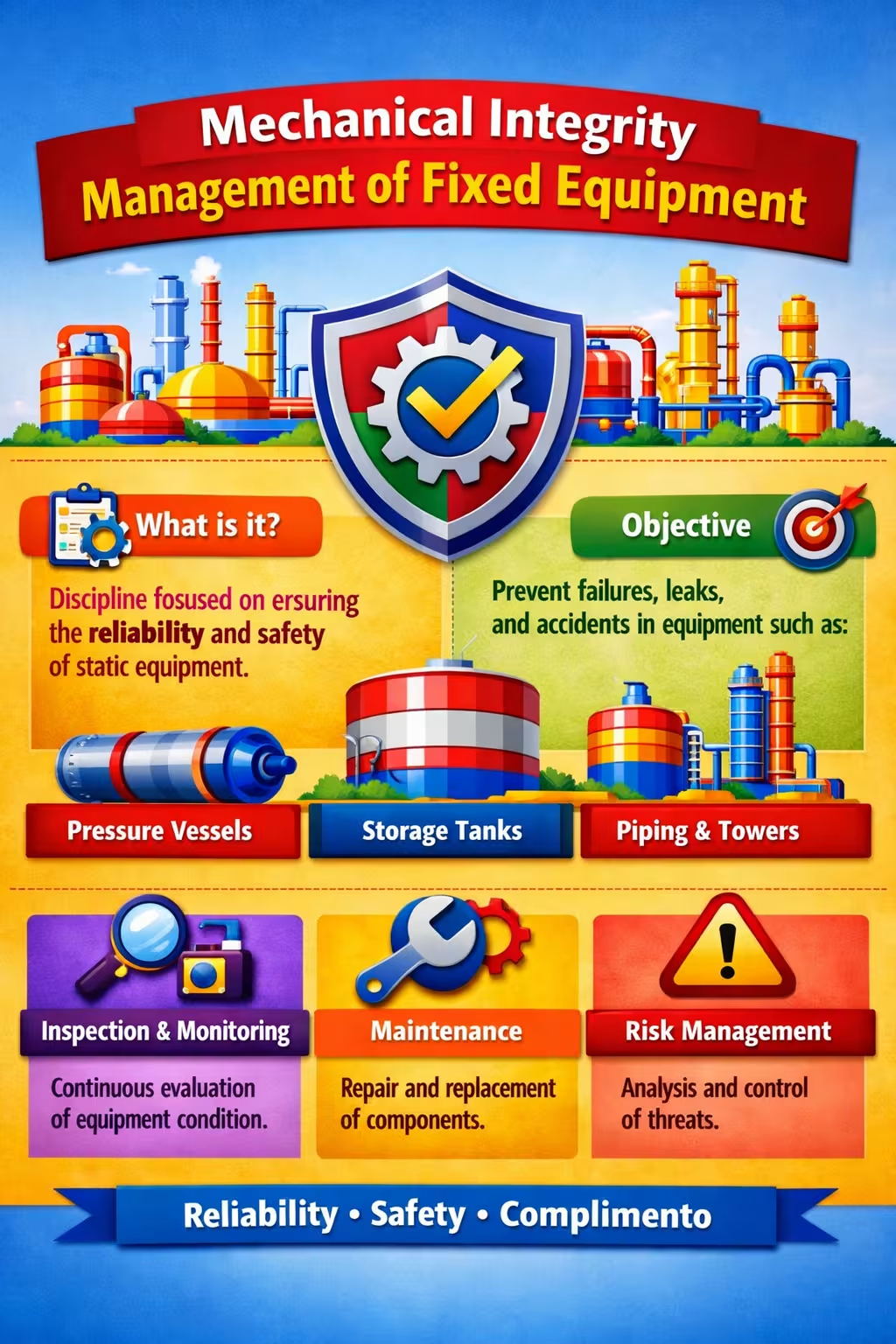
Reliability Program for Fixed Equipment Repair and Improvement:
Methodological Framework and Best Practices in the Process Industry
Subject Area: Reliability Engineering and Mechanical Integrity
Article Type: Technical Review and Industrial Practice Analysis
Governing Standards: ASME BPVC, ASME B31, API 510, API 570, API 579, API 650, API 653, TEMA
Abstract
The management of the mechanical integrity of fixed equipment in industrial process facilities is one of the fundamental pillars for ensuring operational safety, product quality, and business profitability. This article analyzes the methodological framework of a reliability program focused on the repair and improvement of fixed equipment—pressure vessels, piping systems, heat exchangers, and storage tanks—from a technical perspective based on internationally recognized codes and standards. The key elements of the process are described: authorization, design, approval, inspection, testing, and records updating. It is argued that the systematic application of this type of program, grounded in codes such as the ASME Boiler and Pressure Vessel Code, API 510, API 570, API 579, API 650, and API 653, among others, contributes decisively to the reduction of catastrophic failures, the extension of asset service life, and compliance with environmental and safety regulations.
Keywords: mechanical integrity, fixed equipment reliability, industrial repair, API standards, ASME, welding, non-destructive examination.
1. Introduction
In industrial process facilities, the continuous and safe operation of fixed equipment such as pressure vessels, piping systems, heat exchangers, and storage tanks is a sine qua non condition for maintaining operational viability and protecting the safety of personnel, the environment, and physical assets. However, these assets are subject to degradation mechanisms that, over time, compromise their mechanical integrity: corrosion, erosion, fatigue, embrittlement cracking, and other phenomena associated with process conditions (Bloch & Geitner, 2012).
The industry has responded to this challenge through the development of structured reliability programs that establish clear procedures for the detection, evaluation, and correction of defects in fixed equipment. These programs integrate international design and construction standards with operational inspection and maintenance practices, forming an integrity management system that reduces the risk of failures and optimizes maintenance intervals (API 510, 2014; API 570, 2016).
The objective of this article is to describe and analyze the fundamental components of a reliability program for the repair and improvement of fixed equipment, examining its normative basis, its procedural stages, and the technical implications of each phase of the process.
2. Normative Framework of Reference
2.1 Design and Construction Codes
Reliability programs for fixed equipment rest on a solid normative foundation. The ASME Boiler and Pressure Vessel Code (BPVC) establishes the minimum requirements for design, fabrication, inspection, and testing of pressure vessels and boilers (ASME, 2021). Its application is mandatory in most industrial jurisdictions in North America and serves as a reference in numerous countries.
For pressure piping systems, ASME B31—in its various sections, including B31.1 (Power Piping) and B31.3 (Process Piping)—provides the design criteria, materials, fabrication, examination, and inspection requirements governing the integrity of these systems (ASME B31.3, 2022).
2.2 API Standards
The American Petroleum Institute (API) has developed a set of specialized standards for the inspection and integrity management of process equipment in refineries and petrochemical plants:
- API 510 (Pressure Vessel Inspection Code): governs the inspection, rating, repair, and alteration of in-service pressure vessels (API, 2014).
- API 570 (Piping Inspection Code): establishes requirements for inspection, rating, repair, and alteration of in-service process piping systems (API, 2016).
- API 579-1/ASME FFS-1 (Fitness-For-Service): provides fitness-for-service assessment procedures that determine whether equipment with detected damage can continue to operate safely (API/ASME, 2021).
- API 650 and API 653: apply to the design, construction, and inspection of welded steel storage tanks, respectively (API, 2020; API, 2014b).
2.3 Industry Practices
Complementarily, Process Industry Practices (PIP) offer industry-consensus guidelines for the design, construction, and maintenance of process facilities. TEMA (Tubular Exchanger Manufacturers Association) standards govern the design and classification of shell-and-tube heat exchangers (TEMA, 2019).
3. Purpose and Scope of the Reliability Program
3.1 Purpose
The fundamental purpose of a reliability program for the repair and improvement of fixed equipment is to avoid or minimize mechanical integrity problems that adversely affect product quality, business profitability, and the safety of personnel, the plant, and equipment. Additionally, these programs address the environmental aspects of industrial operations, as failures in containment equipment can lead to spills or emissions with significant environmental consequences (Center for Chemical Process Safety, 2010).
The reliability of fixed equipment is directly linked to the prevention of premature failures, the extension of asset service life, and the reduction of unplanned shutdowns—factors that directly impact the economic competitiveness of the facility (Bloch & Geitner, 2012).
3.2 Scope
The program covers repairs and improvements to:
- Pressure vessels (reactors, separators, absorbers, distillation columns)
- Process piping systems
- Heat exchangers (shell-and-tube, plate-type, air-cooled)
- Storage tanks
The interventions considered primarily include those performed by welding, which is the most complex and critical construction process in pressure equipment repair, given its impact on the metallurgical integrity of the component (Lincoln Electric, 2020).
4. Repair and Improvement Process: Fundamental Stages
4.1 Authorization
The first stage of the process is the formal authorization of repair or alteration work. This responsibility rests with the Area Inspector, who must approve the commencement of any work before it begins. For alteration work—understood as any modification that affects the design capacity or structural integrity of the equipment—prior consultation and written approval by the Maintenance Engineer are additionally required (API 510, 2014).
The Area Inspector may grant prior general authorization for limited or routine repairs, provided these are like-in-kind repairs—that is, they reproduce the original design, materials, and procedures without introducing technical changes (API 570, 2016). During authorization, the inspection techniques required during the repair or alteration sequence and the necessary fabrication approvals are designated.
4.2 Repair or Alteration Design
All repair and alteration work must be designed according to the original code to which the equipment was built, or according to the applicable current code. This phase cannot begin without prior approval from the Maintenance Engineer (ASME BPVC, 2021).
For temporary repairs, including on-stream repairs, the selected technique must be discussed with the Maintenance Engineer and the Area Inspector. Temporary repairs are provisional in nature and must be planned for replacement by permanent repairs at the earliest available maintenance opportunity (API 579-1/ASME FFS-1, 2021).
Permanent repairs must restore the mechanical integrity of the equipment to the level of the system design requirement. When it is feasible to take the equipment out of service, the defective area may be removed by cutting out the defective section and replacing it with a component that meets the applicable code. This approach ensures complete integrity restoration and avoids the uncertainties associated with repairs on degraded material (Bloch & Geitner, 2012).
4.3 Approval of Methods and Materials
Before implementation, all methods of design, execution, materials, welding procedures, examination, and testing must be reviewed and approved by the Maintenance Engineer. This pre-approval requirement is especially critical for on-stream welding, which involves additional risks arising from equipment temperature, the presence of process fluids, and the possibility of burn-through of the wall material (Savell, 2012).
The qualification of welding procedures (WPS/PQR) and welders must follow the requirements of the applicable code, typically Section IX of the ASME BPVC for metallic materials (ASME BPVC Sec. IX, 2021). Non-compliance with this requirement has been identified as the root cause in multiple mechanical integrity incidents at industrial facilities (U.S. Chemical Safety and Hazard Investigation Board, 2016).
4.4 Inspection and Testing
Acceptance of a welded repair or alteration requires the application of Non-Destructive Examination (NDE) in conformance with the applicable code. The most commonly used methods include:
- Visual Testing (VT): the first line of verification of work quality.
- Industrial Radiography (RT): for detection of volumetric discontinuities in welds.
- Ultrasonic Testing (UT): including advanced techniques such as TOFD (Time of Flight Diffraction) and Phased Array for precise defect evaluation.
- Magnetic Particle Testing (MT): for detection of surface discontinuities in ferromagnetic materials.
- Liquid Penetrant Testing (PT): for detection of surface-open discontinuities in any metallic material (ASNT, 2016).
Following weld completion, a pressure test in accordance with the applicable code must be performed when practical and deemed necessary. When a pressure test is not practical—for operational, structural, or safety reasons—it may be substituted by NDE, but only after written approval by the Area Inspector and the Maintenance Engineer. This provision is explicitly contemplated in the API codes (API 510, 2014; API 570, 2016).
4.5 Records Updating
Documentation management is a critical element in any reliability program. Temporary repairs must be documented with an indication of the expected replacement timeline. Permanent alterations require complete records to be maintained in the Management of Change (MOC) file, ensuring traceability of all modifications made to the equipment throughout its service life (CCPS, 2010).
Records required by governmental regulations must be retained in accordance with applicable regulatory requirements. Quality assurance/quality control (QA/QC) records for like-in-kind repairs must be filed in the progressive Equipment file, which constitutes the technical history of the asset and enables inspection and reliability engineers to evaluate the evolution of equipment condition over time (API 580, 2016).
5. Roles and Responsibilities
The effectiveness of a reliability program for fixed equipment depends greatly on clarity in the definition of roles and responsibilities. The key stakeholders in this type of program are:
- Area Inspector: responsible for the authorization, supervision, and final acceptance of repair and alteration work. Must be qualified in accordance with API 510 or API 570, as applicable.
- Maintenance Engineer: responsible for approval of repair design and methods, as well as coordination with the reliability team.
- Reliability Engineer: provides technical support in analyzing damage mechanisms, selecting repair techniques, and evaluating fitness-for-service.
- Reliability Technician: executes field activities related to inspection and work monitoring.
- Contract Inspectors: participate in inspection activities under the supervision of the Area Inspector (API 510, 2014).
The coordinated participation of these roles ensures that technical decisions are made with adequate knowledge of equipment condition, process conditions, and regulatory requirements.
6. Discussion: Implications for Safety and Operational Reliability
The systematic implementation of a reliability program for fixed equipment has direct implications across three fundamental dimensions of industrial operations:
Process Safety: The rigorous application of authorization, design, and testing procedures significantly reduces the risk of catastrophic failures such as vessel ruptures, piping leaks, or tank collapse—events that can lead to fires, explosions, or toxic releases (CCPS, 2010).
Operational Reliability: Proper planning of repairs, timely replacement of temporary repairs, and up-to-date equipment records enable anticipation of maintenance needs and reduction of unplanned shutdowns, improving asset availability (Bloch & Geitner, 2012).
Regulatory and Environmental Compliance: Adherence to ASME and API codes, along with maintaining up-to-date records, facilitates compliance with regulatory inspections and reduces the risk of penalties associated with non-compliance. Additionally, prevention of leaks and spills contributes to protection of the natural environment (API 579-1/ASME FFS-1, 2021).
7. Conclusions
The reliability program for fixed equipment repair and improvement analyzed in this article represents a comprehensive and systematic approach to mechanical integrity management in industrial process facilities. Its five stages—authorization, design, approval, inspection and testing, and records updating—form a control cycle that, grounded in industry codes and standards (ASME BPVC, ASME B31, API 510, API 570, API 579, API 650, and API 653), provides the technical and procedural foundations necessary to ensure that repairs and alterations restore and maintain equipment integrity.
Industry experience indicates that full implementation of these programs—qualified as 'Fully Implemented' in the analyzed documentation—is associated with a significant reduction in the frequency of mechanical failures and in the costs associated with emergency repairs. The proactive management of mechanical integrity, through proper repair planning and timely replacement of temporary solutions with permanent ones, is a differentiating factor in facilities with high operational reliability indices.
Future research in this area should focus on the integration of Risk-Based Inspection (RBI) tools and condition data analytics to optimize inspection intervals and prioritize maintenance resources toward the most critical equipment.
References
American Petroleum Institute. (2014a). API 510: Pressure Vessel Inspection Code: In-Service Inspection, Rating, Repair, and Alteration (10th ed.). API Publishing Services.
American Petroleum Institute. (2014b). API 653: Tank Inspection, Repair, Alteration, and Reconstruction (4th ed.). API Publishing Services.
American Petroleum Institute. (2016a). API 570: Piping Inspection Code: In-Service Inspection, Rating, Repair, and Alteration of Piping Systems (4th ed.). API Publishing Services.
American Petroleum Institute. (2016b). API 580: Risk-Based Inspection (3rd ed.). API Publishing Services.
American Petroleum Institute. (2020). API 650: Welded Tanks for Oil Storage (13th ed.). API Publishing Services.
American Petroleum Institute / American Society of Mechanical Engineers. (2021). API 579-1/ASME FFS-1: Fitness-For-Service (3rd ed.). API/ASME.
American Society of Mechanical Engineers. (2021a). ASME Boiler and Pressure Vessel Code, Section VIII: Rules for Construction of Pressure Vessels. ASME.
American Society of Mechanical Engineers. (2021b). ASME Boiler and Pressure Vessel Code, Section IX: Welding, Brazing, and Fusing Qualifications. ASME.
American Society of Mechanical Engineers. (2022). ASME B31.3: Process Piping. ASME.
American Society for Nondestructive Testing. (2016). Nondestructive Testing Handbook (3rd ed., Vols. 1-11). ASNT.
Bloch, H. P., & Geitner, F. K. (2012). Machinery Failure Analysis and Troubleshooting: Practical Machinery Management for Process Plants (4th ed.). Butterworth-Heinemann.
Center for Chemical Process Safety (CCPS). (2010). Guidelines for Process Safety Metrics. John Wiley & Sons / AIChE.
Lincoln Electric Company. (2020). The Procedure Handbook of Arc Welding (15th ed.). Lincoln Electric.
Savell, C. T. (2012). Hot Tapping and In-Service Welding: Codes, Techniques, and Best Practices. ASME Press.
Tubular Exchanger Manufacturers Association. (2019). TEMA Standards for Shell-and-Tube Heat Exchangers (10th ed.). TEMA.
U.S. Chemical Safety and Hazard Investigation Board. (2016). Investigation Reports on Process Industry Incidents. CSB. Retrieved from https://www.csb.gov
Article prepared from the technical analysis of industrial normative documentation on reliability programs and fixed equipment repair in process facilities.
Comments